
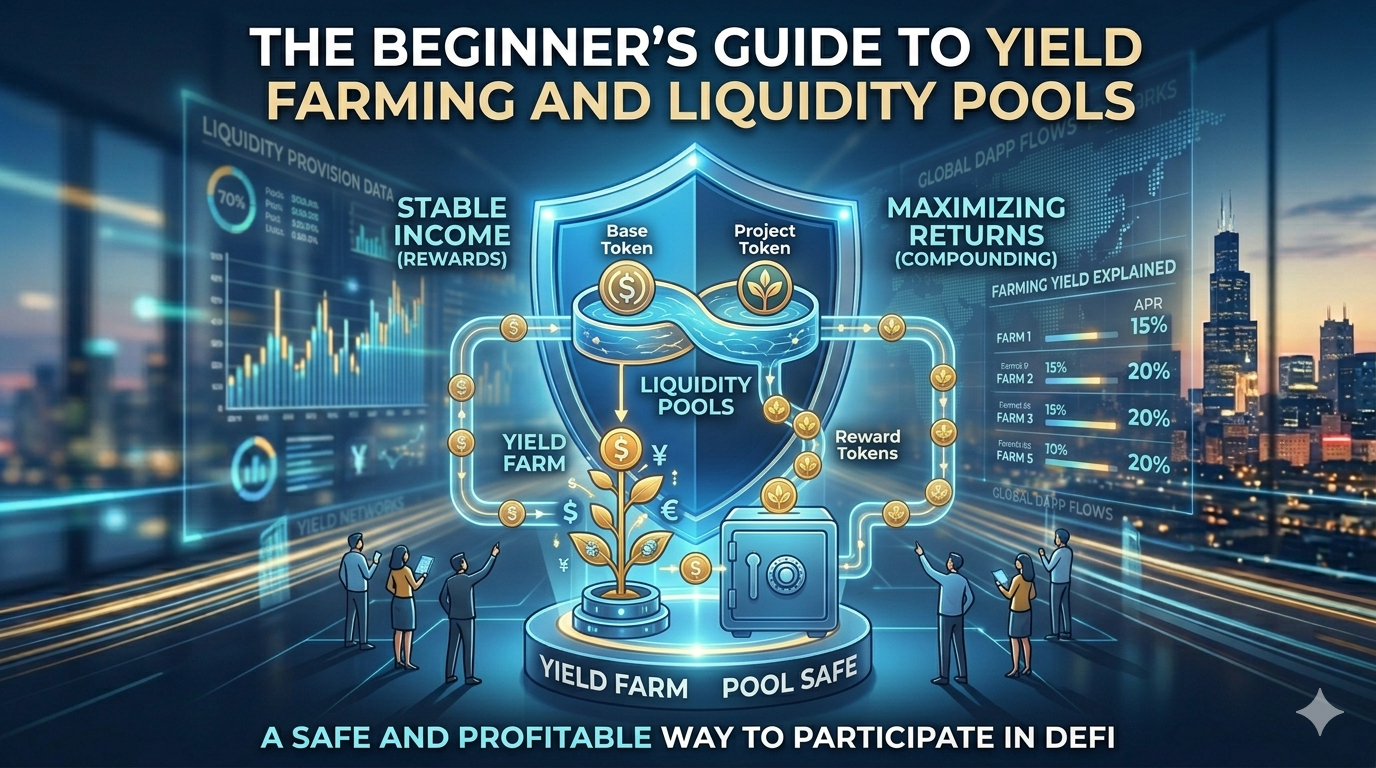
Are you curious about how to earn passive income with cryptocurrency beyond simple holding? Yield farming and liquidity pools offer a powerful way to grow your crypto assets by putting them to work in decentralized finance (DeFi) protocols. At its core, yield farming involves providing liquidity to decentralized exchanges in exchange for rewards—often in the form of additional tokens. This beginner’s guide breaks down exactly how it works, what risks to watch for, and how to get started safely.
What Are Liquidity Pools?
Liquidity pools are smart contract-based reserves of cryptocurrency pairs that power decentralized exchanges (DEXs) like Uniswap, PancakeSwap, or SushiSwap. Instead of relying on traditional order books, these platforms use automated market makers (AMMs), which depend on user-funded pools to enable instant token swaps.
When you contribute equal values of two tokens—say, ETH and USDC—you become a liquidity provider (LP). In return, you receive LP tokens representing your share of the pool. These tokens not only prove your stake but also entitle you to a portion of the trading fees generated by the pool.
- Each trade on a DEX incurs a small fee (typically 0.2%–0.3%)
- Fees are distributed proportionally to all liquidity providers
- Your earnings depend on your share of the total pool
How Does Yield Farming Work?
Yield farming takes liquidity provision a step further. After depositing funds into a liquidity pool, farmers often stake their LP tokens into a separate yield farming contract to earn additional rewards—usually in the platform’s native token (e.g., CAKE on PancakeSwap or UNI on Uniswap).
This layered approach can significantly boost returns, but it also increases complexity. Farmers must monitor multiple variables: impermanent loss, reward token volatility, and protocol sustainability. The goal is to maximize annual percentage yield (APY) while minimizing exposure to downside risks.
Key Components of Yield Farming
- APY/APR: Annual Percentage Yield or Rate—indicates potential returns
- Impermanent Loss: Temporary loss when token prices diverge from your deposit ratio
- Reward Tokens: Often newly minted or low-market-cap assets with high volatility
- Gas Fees: Transaction costs on networks like Ethereum can eat into profits
Getting Started: A Step-by-Step Walkthrough
Ready to dip your toes into yield farming? Follow these practical steps:
- Choose a reliable DeFi platform: Stick to well-audited protocols with strong communities (e.g., Aave, Curve, or Balancer).
- Select a stable or correlated token pair: Pairs like DAI/USDC or ETH/wBTC reduce impermanent loss risk.
- Provide liquidity: Deposit both tokens in equal USD value via the platform’s interface.
- Stake your LP tokens: Find the corresponding farm and stake your receipt tokens to start earning rewards.
- Monitor and manage: Track performance, claim rewards regularly, and exit if risks outweigh rewards.
Risks Every Beginner Should Know
While yield farming can be lucrative, it’s not risk-free. Understanding these pitfalls is essential before committing funds.
Impermanent Loss
This occurs when the price ratio of your deposited tokens changes after you’ve added liquidity. If one token appreciates significantly, you may end up with fewer total tokens than if you had simply held them—even after earning fees.
Smart Contract Vulnerabilities
DeFi protocols run on code. Bugs or exploits can lead to total loss of funds. Always research audit reports and community trust levels before investing.
Token Dilution and Inflation
Many farming rewards come from newly issued tokens. If demand doesn’t keep pace with supply, token prices can plummet—erasing gains.
Key Takeaways
- Yield farming lets you earn passive income by supplying liquidity to DeFi platforms
- Liquidity pools are the foundation—they enable trading and generate fee income
- Higher APY often means higher risk; always assess impermanent loss and tokenomics
- Start small, use reputable platforms, and never invest more than you can afford to lose
- Regular monitoring and timely exits are crucial for long-term success
FAQ
Is yield farming profitable for beginners?
Yes, but with caveats. Beginners can profit by choosing stablecoin pairs and well-established platforms. However, high APYs often signal elevated risk—always do your own research (DYOR) and start with small amounts.
What is impermanent loss, and how can I avoid it?
Impermanent loss happens when the value of your deposited tokens diverges. You can minimize it by providing liquidity for stable or closely correlated assets (e.g., USDT/USDC) or using platforms that offer impermanent loss protection.
Do I need technical knowledge to start yield farming?
Basic familiarity with wallets (like MetaMask), blockchain transactions, and DeFi interfaces is helpful—but not advanced coding skills. Most platforms offer user-friendly dashboards. Focus on learning security best practices, such as verifying contract addresses and avoiding phishing sites.
