
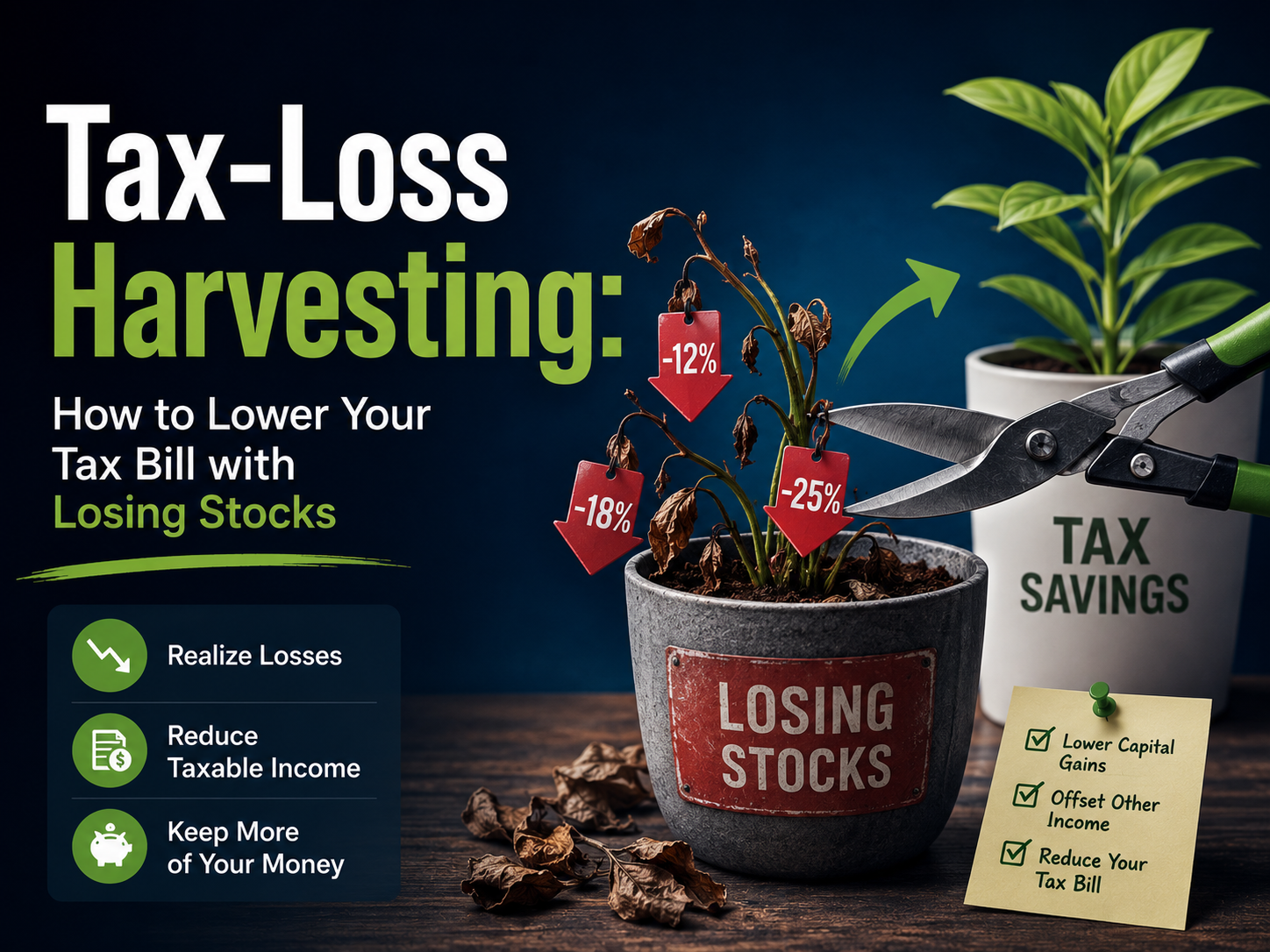
Have you ever held onto a losing stock, hoping it would rebound, only to watch your portfolio dip further? What if that same loss could actually lower your tax bill? That’s exactly what tax-loss harvesting allows you to do. By strategically selling underperforming investments at a loss, you can offset capital gains and reduce your taxable income—sometimes by thousands of dollars.
This powerful tax strategy isn’t just for Wall Street pros. With the right approach, everyday investors can use tax-loss harvesting to turn market downturns into financial opportunities. In this guide, we’ll break down how it works, when to use it, and the rules you must follow to stay compliant.
What Is Tax-Loss Harvesting?
Tax-loss harvesting is the practice of selling investments that have declined in value to realize a capital loss. These losses can then be used to offset capital gains from other profitable investments. If your losses exceed your gains, you can deduct up to $3,000 against ordinary income each year—and carry forward any excess to future tax years.
For example, if you sold a stock for a $5,000 loss and another for a $3,000 gain, you’d offset the gain entirely and still have $2,000 in losses to reduce your taxable income. That’s real money saved, directly from your tax return.
Why Investors Use Tax-Loss Harvesting
- Reduce capital gains taxes: Offset profits from winning stocks or funds.
- Lower ordinary income: Deduct up to $3,000 annually against wages or other income.
- Carry forward losses: Unused losses roll over indefinitely to future years.
- Rebalance portfolios: Sell losers to reallocate funds without triggering high taxes.
How to Harvest Losses the Right Way
Tax-loss harvesting isn’t just about selling losing stocks. It requires planning and awareness of IRS rules to avoid costly mistakes. Here’s how to do it effectively.
1. Identify Underperforming Investments
Start by reviewing your portfolio for positions trading below your purchase price. Focus on stocks, ETFs, or mutual funds with significant unrealized losses. Use brokerage tools or tax software to track cost basis and current market value.
Prioritize assets with the largest losses relative to their original investment. These offer the greatest tax benefit when harvested.
2. Sell and Realize the Loss
Once you’ve identified a losing position, sell it to lock in the capital loss. The sale must be completed by December 31 to count for that tax year. Keep records of the transaction date, sale price, and cost basis for your tax filings.
Remember: You can’t simply sell and immediately buy back the same stock. That brings us to the next critical rule.
3. Beware of the Wash Sale Rule
The IRS wash sale rule prevents investors from claiming a loss if they buy a “substantially identical” security within 30 days before or after the sale. If you violate this rule, the loss is disallowed and added to the cost basis of the new purchase.
To avoid this, wait at least 31 days before repurchasing the same stock. Or, replace it with a similar but not identical investment—like switching from one S&P 500 ETF to another with a different provider.
Advanced Strategies for Maximizing Benefits
Smart investors go beyond basic harvesting. These tactics can amplify your tax savings.
Harvest Losses in High-Income Years
Capital gains are taxed at higher rates when your income is high. If you expect a spike in income—say, from a bonus or retirement withdrawal—harvest losses in that year to offset the increased tax burden.
Use Losses to Offset Short- and Long-Term Gains
Short-term gains (from assets held less than a year) are taxed at your ordinary income rate—often 22% to 37%. Long-term gains are taxed at 0%, 15%, or 20%, depending on income.
Harvesting losses to offset short-term gains delivers the biggest tax savings. But don’t ignore long-term gains—every dollar offset counts.
Reinvest Wisely After Harvesting
After selling a losing position, reinvest the proceeds in a diversified asset that maintains your portfolio’s balance. For example, if you sell a tech stock, consider a broad tech ETF or a different sector altogether.
This keeps your portfolio aligned with your goals while avoiding the wash sale trap.
Key Takeaways
- Tax-loss harvesting lets you use investment losses to reduce your tax bill.
- Sell losing stocks to offset capital gains and deduct up to $3,000 in ordinary income.
- Follow the wash sale rule: don’t buy back the same stock within 30 days.
- Harvest losses in high-income years for maximum impact.
- Reinvest proceeds in similar but not identical assets to maintain portfolio balance.
FAQ: Tax-Loss Harvesting Explained
Can I harvest losses in a retirement account like an IRA?
No. Tax-loss harvesting only applies to taxable brokerage accounts. Losses in IRAs, 401(k)s, and other tax-advantaged accounts don’t generate deductible losses because gains and losses inside these accounts aren’t taxed annually.
What if my losses are more than $3,000?
You can deduct up to $3,000 per year against ordinary income. Any excess losses carry forward to future tax years indefinitely. For example, a $10,000 loss lets you deduct $3,000 now and $3,000 in each of the next two years, with $1,000 remaining.
Is tax-loss harvesting worth it for small portfolios?
Yes—if done correctly. Even a few hundred dollars in losses can offset gains or reduce taxable income. The key is consistency. Review your portfolio quarterly and harvest losses when opportunities arise, especially during market downturns.
With careful planning, tax-loss harvesting turns market setbacks into strategic advantages. Don’t let losing stocks drain your portfolio—let them help lower your tax bill instead.
