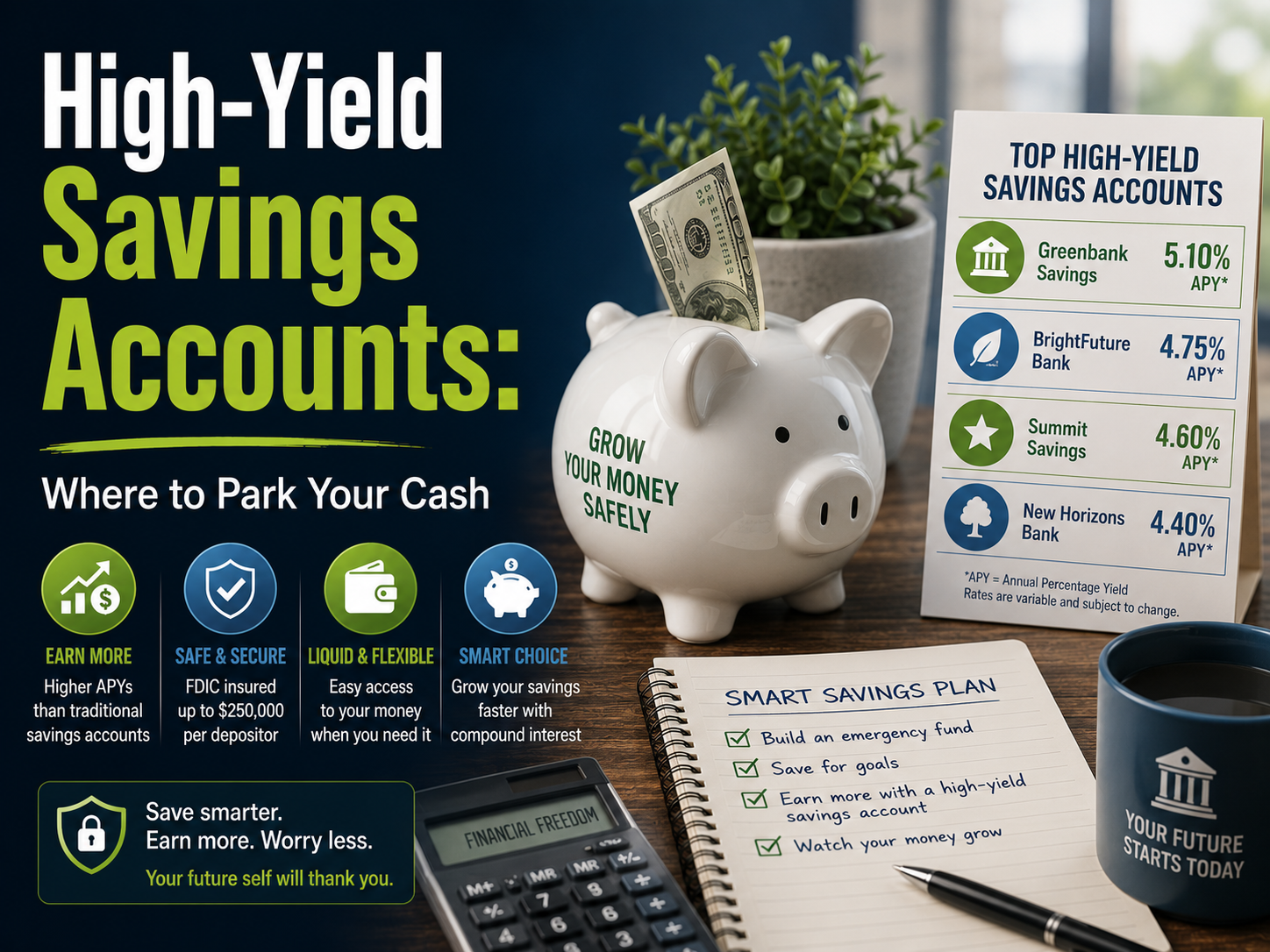
Looking for a safe, smart place to grow your emergency fund or short-term savings? High-yield savings accounts offer significantly better returns than traditional savings accounts—without exposing your money to market risk. If you’re tired of earning less than 0.5% APY at your local bank, it’s time to explore high-yield savings accounts from online banks and credit unions that prioritize competitive interest rates and low fees.
Why Choose a High-Yield Savings Account?
High-yield savings accounts are designed for one purpose: to help your cash grow faster while remaining easily accessible. Unlike certificates of deposit (CDs) or investment accounts, these accounts offer liquidity and federal insurance—typically through the FDIC or NCUA—up to $250,000 per depositor.
With interest rates often exceeding 4% or even 5% APY, high-yield savings accounts outperform standard bank savings by a wide margin. This makes them ideal for goals like building an emergency fund, saving for a down payment, or stashing cash before a big purchase.
- Higher interest rates than traditional banks
- FDIC or NCUA insured up to $250,000
- No market risk—your principal is protected
- Easy access to funds via transfers or debit cards
Top Institutions Offering High-Yield Savings Accounts
Not all high-yield savings accounts are created equal. The best options come from online banks and credit unions that operate with lower overhead costs, allowing them to pass savings on to customers in the form of higher APYs.
Online Banks Leading the Pack
Online banks like Ally Bank, Marcus by Goldman Sachs, and Discover Bank consistently rank among the top providers of high-yield savings accounts. These institutions offer competitive rates, user-friendly digital platforms, and no monthly maintenance fees.
For example, as of mid-2024, several online banks are offering APYs above 4.5%, with some promotional rates reaching 5.0% or more for new customers. These rates are recalculated daily and compounded monthly, maximizing your earnings over time.
Credit Unions with Competitive Rates
Don’t overlook credit unions. Many, such as Alliant Credit Union and PenFed Credit Union, offer high-yield savings accounts with rates rivaling those of online banks. Plus, credit unions often provide personalized service and member benefits like lower loan rates.
While credit unions may have membership requirements, many are easy to join through community affiliations or small donations to partner organizations.
What to Look for in a High-Yield Savings Account
Before opening an account, compare key features to ensure you’re getting the best deal. Not every high-yield account is worth your time—some come with hidden fees or restrictive terms.
- Annual Percentage Yield (APY): Aim for accounts offering at least 4.0% APY or higher.
- Minimum balance requirements: Some accounts require $1,000 or more to earn the advertised rate.
- Monthly fees: Avoid accounts with maintenance fees; many top providers charge none.
- Accessibility: Check transfer limits, ATM access, and mobile app functionality.
- Customer service: Look for 24/7 support and positive user reviews.
How High-Yield Savings Accounts Compare to Other Options
While high-yield savings accounts aren’t the highest-yielding investment, they strike the perfect balance between safety, liquidity, and return. Here’s how they stack up against alternatives:
- Traditional savings accounts: Typically offer 0.01% to 0.50% APY—far below inflation.
- Money market accounts: Similar rates and features, but may come with check-writing privileges.
- Certificates of Deposit (CDs): Higher rates possible, but your money is locked in for a set term.
- Treasury bills or I-bonds: Government-backed and safe, but less liquid and more complex to manage.
For most savers, a high-yield savings account is the best starting point for growing cash reserves without complexity or risk.
Tips to Maximize Your Savings Growth
Once you’ve opened a high-yield savings account, use these strategies to boost your returns:
- Automate transfers: Set up recurring deposits from your checking account to build savings effortlessly.
- Monitor rate changes: Online banks may lower rates over time—be ready to switch if a better offer appears.
- Ladder multiple accounts: Open accounts at different institutions to take advantage of promotional rates.
- Avoid excessive withdrawals: Some accounts limit withdrawals to six per month; exceeding this may trigger fees.
Key Takeaways
- High-yield savings accounts offer safe, liquid growth for your cash with APYs often above 4%.
- Top providers include online banks like Ally, Marcus, and Discover, as well as credit unions like Alliant.
- Look for no fees, low minimums, and strong digital tools when choosing an account.
- Use automation and rate monitoring to maximize your earnings over time.
FAQ
Are high-yield savings accounts safe?
Yes. As long as the bank is FDIC-insured or the credit union is NCUA-insured, your deposits are protected up to $250,000 per account holder. This makes them one of the safest places to keep your money.
Can I lose money in a high-yield savings account?
No. Unlike stocks or mutual funds, high-yield savings accounts do not fluctuate in value. Your principal remains intact, and you earn interest on top of it—guaranteed by the financial institution and backed by federal insurance.
How often do interest rates change?
Interest rates on high-yield savings accounts can change at any time, usually in response to Federal Reserve rate adjustments. Most banks update their APYs monthly or quarterly, so it’s wise to check your account regularly.
