
If you’re just starting your investment journey, you’ve likely come across two popular options: index funds and mutual funds. Both offer a way to diversify your portfolio without picking individual stocks, but they differ significantly in cost, management, and performance. For beginners, the choice between index funds and mutual funds often comes down to simplicity, fees, and long-term growth potential. In short, index funds are generally better for beginners due to their low costs, passive management, and consistent market-matching returns.
What Are Index Funds?
Index funds are a type of mutual fund or exchange-traded fund (ETF) designed to track the performance of a specific market index, such as the S&P 500 or the NASDAQ-100. Instead of trying to beat the market, they aim to mirror it. This passive investment strategy means lower operating costs and fewer portfolio changes, which translates to lower fees for investors.
Because index funds follow a set index, they require minimal oversight from fund managers. This hands-off approach reduces human error and emotional decision-making, making them ideal for new investors who want a “set it and forget it” strategy. Over time, their low expense ratios and broad market exposure have consistently outperformed many actively managed funds.
What Are Mutual Funds?
Mutual funds pool money from multiple investors to buy a diversified portfolio of stocks, bonds, or other securities. Unlike index funds, most mutual funds are actively managed. Professional fund managers make decisions about which assets to buy or sell, aiming to outperform the market.
While this active management can lead to higher returns in skilled hands, it often comes with higher fees. These include management expense ratios (MERs), sales loads, and transaction costs. For beginners, these added expenses can eat into returns, especially when many actively managed funds fail to beat their benchmark indexes over the long term.
Key Differences Between Index Funds and Mutual Funds
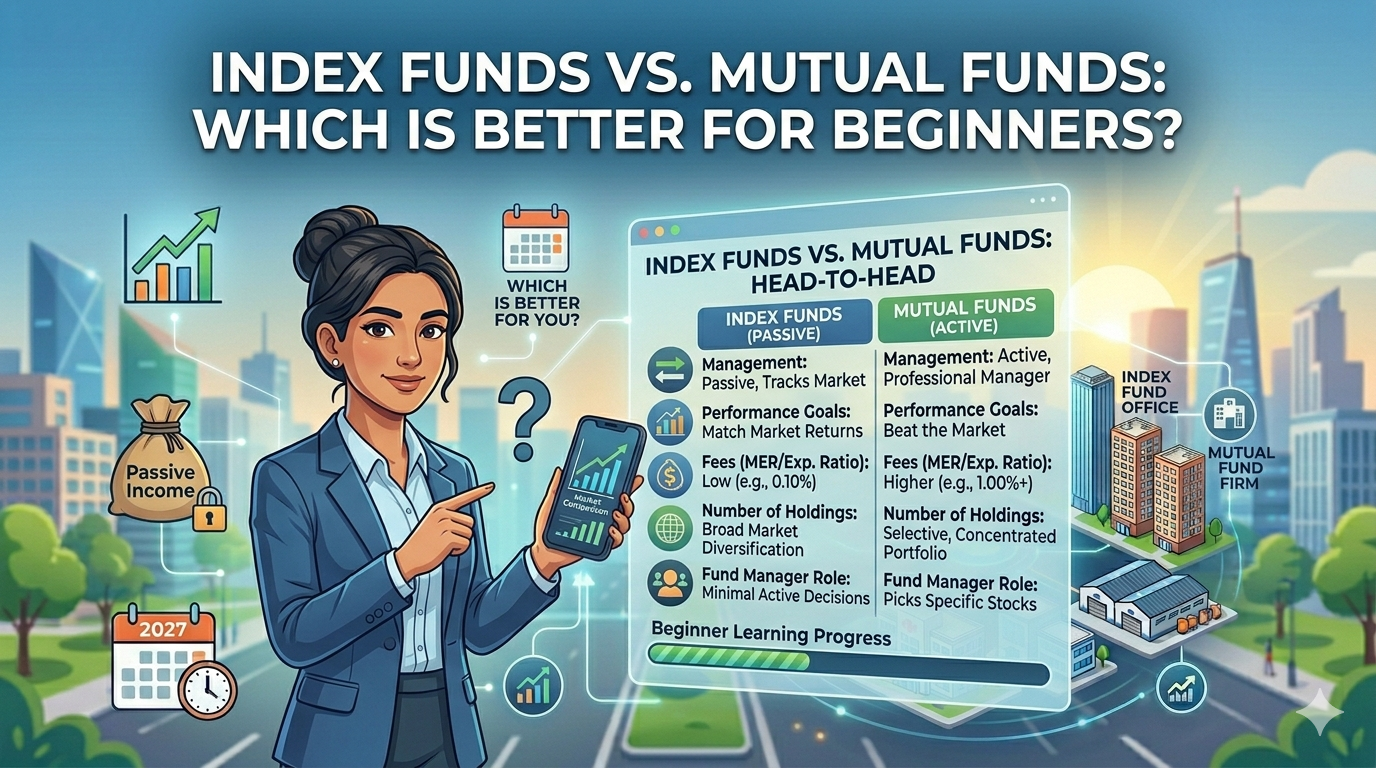
- Management Style: Index funds are passively managed; mutual funds are often actively managed.
- Fees: Index funds typically have lower expense ratios (often under 0.20%), while mutual funds can charge 1% or more.
- Performance: Over time, most actively managed mutual funds underperform their benchmarks, whereas index funds consistently match market returns.
- Minimum Investments: Some mutual funds require higher initial investments, while many index funds (especially ETFs) can be started with as little as the price of one share.
- Tax Efficiency: Index funds tend to be more tax-efficient due to lower turnover rates.
Why Index Funds Are Better for Beginners
For someone new to investing, simplicity and cost matter most. Index funds eliminate the need to research individual stocks or time the market. They offer instant diversification across hundreds of companies, reducing risk without requiring deep financial knowledge.
Additionally, their low fees mean more of your money stays invested and compounds over time. Studies show that over a 20-year period, even a 1% difference in fees can cost investors tens of thousands in lost returns. Beginners benefit greatly from keeping costs low while building wealth steadily.
Another advantage is transparency. Since index funds track well-known indexes, you always know what you’re invested in. There’s no guessing about a fund manager’s strategy or hidden holdings.
When Might Mutual Funds Be a Better Choice?
While index funds are usually the smarter start, mutual funds aren’t obsolete. In certain cases, actively managed funds can add value—especially in less efficient markets like small-cap stocks or emerging markets, where skilled managers may spot opportunities index funds miss.
Some investors also prefer the reassurance of professional oversight, especially during volatile markets. If you’re uncomfortable with fully passive investing or want exposure to niche sectors, a well-chosen mutual fund might complement your portfolio.
However, beginners should be cautious. High fees and inconsistent performance make most mutual funds a riskier bet for long-term growth. Always research the fund’s track record, fees, and manager tenure before investing.
How to Get Started: A Beginner’s Guide
Starting with index funds is straightforward. Here’s how:
- Choose a brokerage: Look for platforms with no trading fees and low minimums (e.g., Fidelity, Vanguard, or Charles Schwab).
- Pick a broad-market index fund: Examples include VTI (Vanguard Total Stock Market ETF) or FXAIX (Fidelity 500 Index Fund).
- Set up automatic investments: Consistency beats timing. Invest a fixed amount regularly, regardless of market conditions.
- Reinvest dividends: This boosts compound growth over time.
- Stay the course: Avoid reacting to short-term market swings. Long-term holding is key.
Key Takeaways
- Index funds are typically better for beginners due to lower fees, passive management, and market-matching performance.
- Mutual funds offer active management but often come with higher costs and inconsistent results.
- For most new investors, starting with a low-cost index fund provides the best balance of risk, return, and simplicity.
- Always compare expense ratios, minimum investments, and historical performance before choosing any fund.
FAQ
Are index funds safer than mutual funds?
Not necessarily safer in terms of risk, but they are more predictable. Both invest in the market, so they carry similar market risk. However, index funds’ lower fees and consistent strategy make them more reliable for long-term growth.
Can I lose money in index funds?
Yes. Like all market investments, index funds can lose value during market downturns. However, because they track the entire market, they tend to recover over time, making them a solid choice for long-term investors.
Do I need a financial advisor to invest in index funds?
No. Many beginners successfully manage their own index fund portfolios using online brokers and free resources. A financial advisor may help with complex goals, but it’s not required to start investing.
