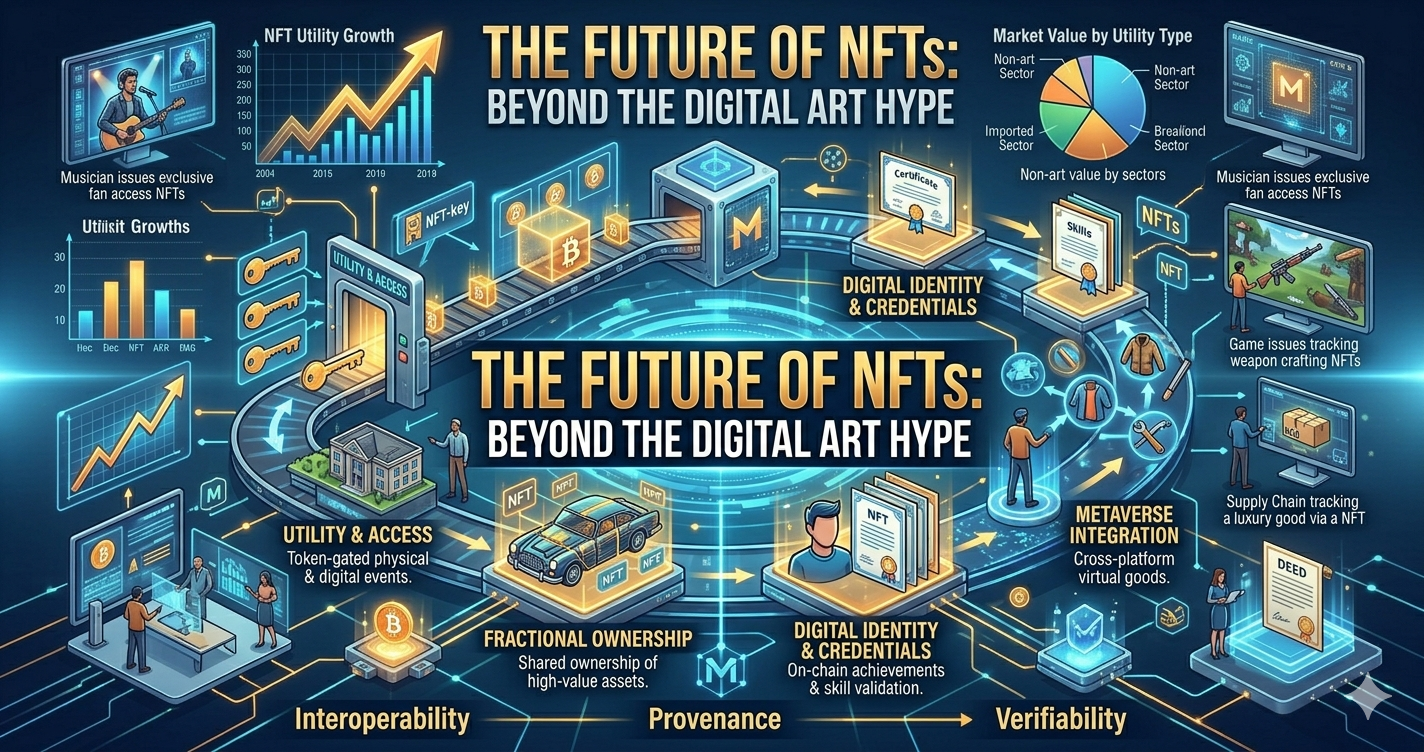
Non-fungible tokens (NFTs) exploded into mainstream awareness through digital art sales, viral memes, and celebrity endorsements. But as the initial frenzy fades, a more meaningful evolution is taking shape. The future of NFTs is no longer just about JPEGs selling for millions—it’s about utility, ownership, and real-world integration. Beyond the digital art hype, NFTs are becoming foundational tools in gaming, identity verification, intellectual property, and decentralized finance.
While early adopters focused on speculative trading, forward-thinking developers and enterprises are reimagining NFTs as dynamic assets with embedded functionality. From tokenized real estate to verifiable credentials and supply chain tracking, the technology is maturing beyond collectibles. This shift marks a critical turning point: NFTs are transitioning from internet curiosities to essential components of digital infrastructure.
What’s Driving the Next Phase of NFT Innovation?
The decline in speculative trading has cleared the noise, allowing genuine use cases to emerge. Blockchain scalability improvements, lower transaction fees, and enhanced smart contract capabilities have made NFTs more practical for everyday applications. Meanwhile, regulatory clarity in key markets is encouraging institutional participation.
Key drivers include:
- Interoperability: Cross-chain compatibility allows NFTs to move between platforms, increasing their utility.
- Dynamic metadata: NFTs can now update in real time based on external data, enabling responsive digital assets.
- Fractional ownership: High-value assets like real estate or fine art can be divided into tradable NFT shares.
- Identity and access: NFTs serve as digital passports for events, memberships, and online communities.
NFTs in Gaming: Play-to-Earn Evolves into Play-and-Own
Gaming has long been a proving ground for NFT utility. Early play-to-earn models faced criticism for unsustainable economies, but newer platforms are focusing on balanced ecosystems where NFTs represent meaningful in-game assets—weapons, land, characters—that players truly own.
Unlike traditional games where items vanish if a server shuts down, NFT-based assets remain under user control. This empowers players to trade, sell, or use items across multiple games. Studios like Ubisoft and Square Enix are experimenting with NFT integration, signaling industry-wide acceptance.
Moreover, blockchain-based games are enabling true digital scarcity. A rare sword isn’t just a visual effect—it’s a verifiable, scarce digital object with provable ownership. This shifts power from developers to players, creating more equitable gaming economies.
Tokenizing the Physical World: Real-World Assets (RWAs)
One of the most promising frontiers for NFTs is the tokenization of real-world assets (RWAs). From luxury watches and real estate to carbon credits and intellectual property, physical items are being represented as NFTs on blockchain networks.
This process enhances transparency, reduces fraud, and enables fractional investment. Imagine owning 1% of a Picasso painting or a beachfront villa through an NFT. These assets can be traded 24/7 on decentralized marketplaces, democratizing access to high-value markets.
Startups like Propy and RealT are already facilitating real estate transactions using NFTs, while platforms like Securitize are tokenizing private equity and bonds. As regulatory frameworks evolve, RWA tokenization could unlock trillions in previously illiquid assets.
Identity, Credentials, and the Decentralized Web
NFTs are redefining digital identity. Instead of relying on centralized platforms to verify credentials, individuals can store academic degrees, professional certifications, and work history as NFTs. These verifiable credentials are tamper-proof and portable across platforms.
Universities like MIT and institutions in Estonia are piloting blockchain-based diplomas. Job seekers can share a single NFT that proves their qualifications without revealing unnecessary personal data. This enhances privacy while streamlining verification.
In the decentralized web (Web3), NFT-based identities could replace traditional logins. Your digital wallet becomes your universal ID, granting access to services, voting in DAOs, or proving membership in exclusive communities—all without intermediaries.
Challenges on the Horizon
Despite the progress, significant hurdles remain. Environmental concerns around energy-intensive blockchains have led to a shift toward proof-of-stake networks like Ethereum 2.0, but sustainability remains a priority.
Legal ambiguity around ownership rights, copyright, and taxation continues to slow adoption. Can an NFT grant full intellectual property rights? Who owns derivative works? These questions require clear legal frameworks.
User experience also needs improvement. Managing wallets, private keys, and gas fees remains daunting for non-technical users. Mass adoption depends on seamless, intuitive interfaces that hide blockchain complexity.
Key Takeaways
- The future of NFTs extends far beyond digital art, focusing on utility, ownership, and real-world integration.
- Gaming, real estate, identity, and finance are leading sectors adopting NFT technology.
- Interoperability, dynamic metadata, and fractional ownership are expanding NFT functionality.
- Regulatory clarity and improved user experience are critical for mainstream adoption.
- NFTs are evolving from speculative assets into foundational tools for the decentralized economy.
FAQ
Are NFTs still relevant after the market crash?
Yes. While speculative trading has declined, the underlying technology is being adopted for practical, high-value applications. The focus has shifted from hype to utility.
Can NFTs represent physical items?
Absolutely. Through tokenization, physical assets like real estate, art, and luxury goods can be represented as NFTs, enabling secure, transparent ownership and trading.
How do NFTs improve digital identity?
NFTs allow individuals to store verifiable credentials—such as degrees or certifications—on the blockchain. These are tamper-proof, portable, and give users full control over their personal data.
