
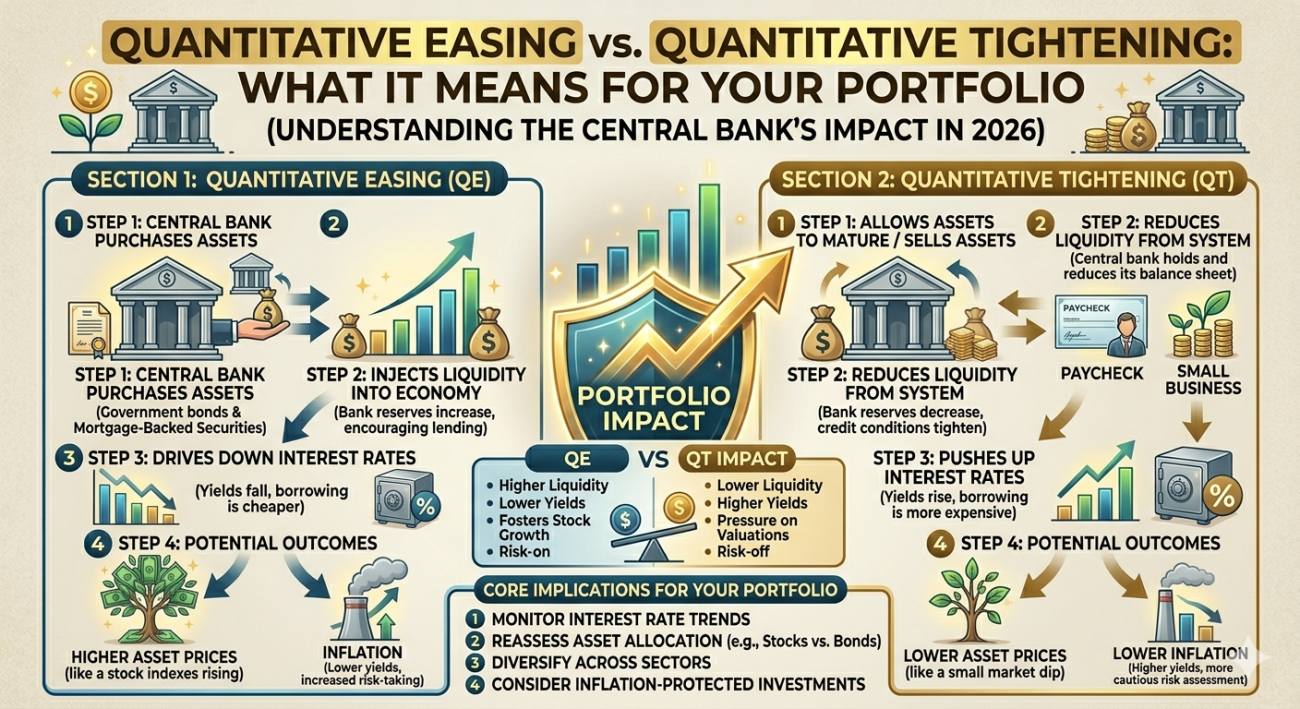
Are your investments feeling the ripple effects of central bank policy shifts? Quantitative easing vs. quantitative tightening represents two opposing monetary tools used by central banks to influence economic growth, inflation, and financial markets—and both have direct consequences for your portfolio. Whether you’re a seasoned investor or just starting out, understanding how these policies work can mean the difference between capitalizing on market trends or getting caught off guard.
Quantitative easing (QE) floods the financial system with liquidity by having central banks buy government and corporate bonds. In contrast, quantitative tightening (QT) reverses this process by reducing the central bank’s balance sheet—selling assets or letting them mature without reinvestment. These actions shape interest rates, bond yields, stock valuations, and even real estate prices. For investors, the shift from QE to QT—or vice versa—can trigger volatility, alter asset performance, and redefine risk.
What Is Quantitative Easing?
Quantitative easing is an unconventional monetary policy used when traditional tools—like lowering short-term interest rates—are no longer effective, typically during recessions or periods of deflationary pressure. Central banks, such as the U.S. Federal Reserve or the European Central Bank, purchase long-term securities from the open market to inject money directly into the financial system.
The goal? To lower long-term interest rates, encourage lending, boost asset prices, and stimulate economic activity. During the 2008 financial crisis and again during the 2020 pandemic, QE played a pivotal role in stabilizing markets. By increasing demand for bonds, QE pushes bond prices up and yields down, making borrowing cheaper for businesses and consumers.
- Increases liquidity in financial markets
- Lowers long-term interest rates
- Supports higher asset valuations, especially in equities and real estate
- Encourages risk-taking as investors seek higher returns
For your portfolio, QE often creates a favorable environment for growth stocks, high-yield bonds, and alternative investments. However, prolonged QE can also lead to asset bubbles and distort market pricing mechanisms.
What Is Quantitative Tightening?
Quantitative tightening is the opposite of QE. It occurs when a central bank reduces its balance sheet by selling assets or allowing bonds to mature without reinvesting the proceeds. QT is typically implemented when the economy is overheating, inflation is rising, or the central bank wants to normalize policy after a period of expansionary measures.
By pulling money out of the financial system, QT aims to tighten financial conditions, raise long-term interest rates, and curb inflationary pressures. The process can be gradual and is often communicated well in advance to avoid market shocks. For example, the Federal Reserve began QT in 2017 after years of post-crisis QE, and again in 2022 as inflation surged.
- Reduces money supply and liquidity
- Increases long-term interest rates
- Puts downward pressure on asset prices
- Encourages conservative investing and risk reduction
For investors, QT can lead to higher borrowing costs, lower stock valuations, and increased market volatility. Sectors like technology and growth stocks—which thrive in low-rate environments—may underperform, while value stocks and dividend-paying equities could become more attractive.
How QE and QT Impact Your Investment Portfolio
The shift between quantitative easing and quantitative tightening directly influences portfolio performance. Understanding these dynamics helps you adjust your asset allocation, manage risk, and seize opportunities.
1. Bond Market Effects
During QE, central bank bond purchases suppress yields and inflate prices. This benefits existing bondholders but makes it harder for new investors to find attractive yields. Conversely, QT increases bond supply in the market, pushing yields higher and prices lower.
Investors should consider duration risk—longer-term bonds are more sensitive to interest rate changes. In a QT environment, short-duration or floating-rate bonds may offer better protection.
2. Equity Market Performance
QE tends to boost equity markets by lowering discount rates and encouraging risk appetite. Growth stocks, especially in tech, often outperform. QT, however, can weigh on valuations as higher rates increase the cost of capital and reduce future earnings projections.
Historically, the S&P 500 has experienced increased volatility during QT periods. Investors may benefit from rotating into defensive sectors like utilities, consumer staples, or dividend aristocrats.
3. Real Estate and Alternative Investments
Low rates during QE make real estate more affordable and attractive, driving up property values and REIT performance. QT reverses this trend by increasing mortgage rates and tightening credit, potentially cooling the housing market.
Alternative assets like private equity and infrastructure may also feel the pinch during QT due to higher financing costs and reduced liquidity.
4. Currency and International Markets
QE can weaken a nation’s currency as increased money supply reduces its value. This benefits exporters but hurts importers. QT, by contrast, can strengthen the currency, impacting multinational companies and foreign investments.
Emerging markets are particularly sensitive. QE in developed nations often leads to capital inflows into higher-yielding emerging assets. QT can trigger capital flight, increasing volatility in those regions.
Historical Examples: Lessons from Past Cycles
The 2008–2014 period offers a textbook example of QE in action. The Federal Reserve launched multiple rounds of asset purchases, expanding its balance sheet from under $1 trillion to over $4.5 trillion. Equity markets rebounded, corporate borrowing surged, and risk assets flourished.
When the Fed began QT in 2017, the balance sheet shrank by nearly $800 billion over three years. While the initial phase was smooth, the 2018 market correction and the 2019 repo market crisis highlighted the fragility of liquidity-dependent markets.
More recently, the 2020 pandemic response saw unprecedented QE, with the Fed’s balance sheet exceeding $8.9 trillion. As inflation spiked in 2022, the central bank pivoted sharply to QT, reducing its holdings by over $1 trillion by 2024. This rapid shift contributed to market turbulence, especially in growth and tech stocks.
These cycles underscore a key insight: the transition from QE to QT is often more disruptive than the policies themselves. Investors who anticipate these shifts can position their portfolios accordingly.
How to Position Your Portfolio for QE and QT Cycles
Smart investors don’t just react—they prepare. Here’s how to adapt your strategy based on the current monetary environment.
During Quantitative Easing:
- Increase exposure to growth assets: Stocks, especially in innovation-driven sectors
- Consider high-yield bonds: With low rates, credit risk may be worth the premium
- Explore real estate and REITs: Benefiting from cheap financing
- Diversify into alternatives: Private equity, venture capital, or commodities
During Quantitative Tightening:
- Shift toward value and dividend stocks: More resilient in higher-rate environments
- Shorten bond duration: Reduce sensitivity to rising rates
- Hold more cash or cash equivalents: Liquidity becomes valuable
- Hedge with inflation-protected securities: TIPS or inflation-linked bonds
It’s also wise to monitor central bank communications. Statements from the Fed, ECB, or Bank of England often signal upcoming policy shifts. Forward guidance can give investors a head start in adjusting their portfolios.
Key Takeaways
- Quantitative easing expands the money supply, lowers rates, and supports risk assets—ideal for growth investing.
- Quantitative tightening reduces liquidity, raises rates, and pressures valuations—favoring defensive strategies.
- Both policies impact bonds, stocks, real estate, and currencies, requiring dynamic portfolio adjustments.
- Historical cycles show that transitions between QE and QT are often the most volatile phases.
- Investors should monitor central bank actions and align asset allocation with the prevailing monetary regime.
FAQ
What’s the main difference between quantitative easing and quantitative tightening?
Quantitative easing involves central banks buying assets to inject money into the economy, lowering interest rates and boosting asset prices. Quantitative tightening is the reverse—central banks reduce their balance sheets by selling assets or halting reinvestments, which pulls money out of the system, raises rates, and can cool down overheated markets.
How does QT affect my 401(k) or retirement portfolio?
QT can lead to higher interest rates and lower stock valuations, potentially reducing the value of equity-heavy retirement accounts. However, it may also make bonds more attractive over time. Diversification and periodic rebalancing can help manage this risk.
Can quantitative tightening cause a recession?
While QT itself doesn’t cause recessions, aggressive tightening—especially when combined with high inflation and slowing growth—can increase the risk. Central banks aim to tighten gradually to avoid triggering downturns, but missteps can lead to economic contraction.
