
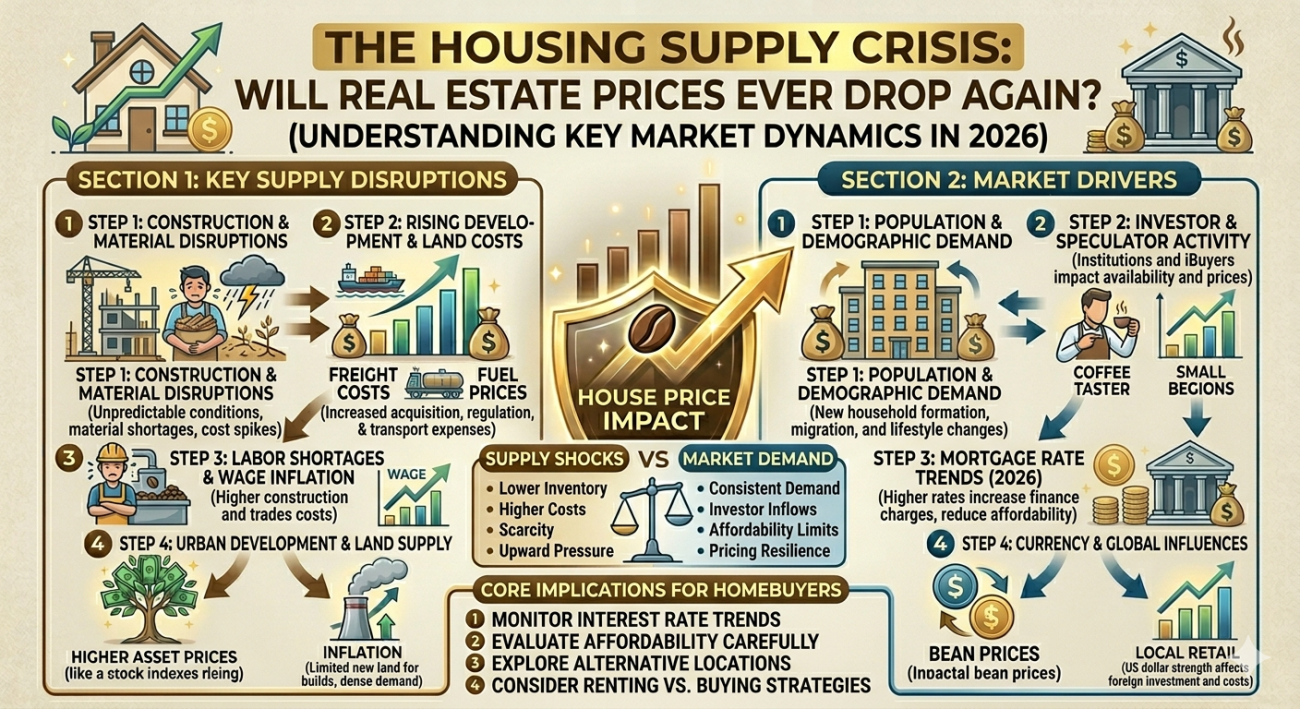
Will real estate prices ever drop again? That’s the million-dollar question on the minds of buyers, investors, and economists alike. With home values skyrocketing over the past decade, many are wondering if the current housing supply crisis has permanently shifted the market. The short answer: while prices may dip temporarily, a sustained, widespread drop in real estate prices is unlikely without a major structural shift in housing availability, economic conditions, or policy intervention.
The root of today’s dilemma lies in a simple but powerful imbalance: demand far outpaces supply. Millennials are entering peak homebuying years, remote work has expanded where people want to live, and investor activity remains strong. Yet, construction has failed to keep up. Decades of underbuilding, zoning restrictions, labor shortages, and rising material costs have created a deficit of millions of homes across the U.S. and other developed nations. This housing supply crisis isn’t just a temporary blip—it’s a long-term structural issue that continues to prop up prices.
Why the Housing Supply Crisis Is Driving Prices Up
The housing supply crisis is more than just a shortage of homes—it’s a systemic failure in how we build and allocate housing. For over 15 years, new construction has lagged behind household formation. According to the National Association of Realtors, the U.S. faces a deficit of approximately 3.8 million homes. This gap means that even if demand stabilizes, prices will remain elevated simply because there aren’t enough homes to go around.
Several factors contribute to this chronic undersupply:
- Zoning and land-use regulations restrict high-density development in many desirable areas, limiting the number of units that can be built.
- Construction costs have soared due to inflation, supply chain disruptions, and labor shortages, making new builds less profitable for developers.
- NIMBYism (“Not In My Backyard”) has slowed or blocked new housing projects in urban and suburban neighborhoods, preserving low-density zoning.
- Investor activity has absorbed a growing share of available inventory, particularly in entry-level and mid-tier markets.
Together, these forces have created a market where even modest price corrections are quickly absorbed by eager buyers. In many cities, homes sell within days of listing, often above asking price. This level of competition makes it nearly impossible for prices to fall significantly without a major economic shock.
Can Real Estate Prices Drop in a Supply-Constrained Market?
History shows that real estate prices can and do fall—but usually under specific conditions. The 2008 housing crash was driven by reckless lending, speculative buying, and an oversupply of homes. Today’s market is fundamentally different. There’s no bubble of subprime mortgages, and inventory remains tight. As a result, any price declines are likely to be localized and temporary.
For example, during periods of rising interest rates—like the Federal Reserve’s aggressive hikes in 2022 and 2023—buyer demand softened, leading to slight price adjustments in some markets. Cities like Austin, Boise, and Phoenix saw price dips of 5–10% after pandemic-era surges. However, these corrections were short-lived. Once rates stabilized and demand returned, prices rebounded quickly due to limited supply.
Even in a recession, a broad-based drop in real estate prices would require either a collapse in demand or a sudden surge in supply—neither of which is currently on the horizon. Unemployment would need to rise sharply, or millions of new homes would need to flood the market overnight. Neither scenario is likely in the near term.
The Role of Policy and Innovation in Easing the Crisis
While market forces dominate, government policy and innovation could play a role in easing the housing supply crisis—and potentially moderating prices. Some promising developments include:
- Zoning reform: Cities like Minneapolis and states like California have begun allowing duplexes and accessory dwelling units (ADUs) in single-family zones, increasing density without high-rise construction.
- Modular and prefabricated housing: These construction methods can reduce build times and costs, potentially increasing supply faster than traditional methods.
- Public-private partnerships: Governments are partnering with developers to build affordable housing, often on underutilized public land.
- Tax incentives for builders: Some jurisdictions offer tax breaks for developers who include affordable units or build in high-need areas.
However, these solutions face political and logistical hurdles. Zoning changes often meet fierce resistance from existing homeowners. Modular housing still accounts for less than 5% of new construction. And while federal and state funding for affordable housing has increased, it’s still far short of what’s needed to close the supply gap.
Will Real Estate Prices Ever Drop Again? A Realistic Outlook
So, will real estate prices ever drop again? In the traditional sense—like the 30–40% declines seen during the 2008 crash—the answer is probably not, at least not without a severe economic downturn or a major shift in housing policy. But that doesn’t mean prices will keep climbing forever.
More likely, we’ll see a market characterized by price stabilization rather than decline. As interest rates normalize and construction slowly ramps up, price growth may slow to match inflation or wage growth. In some overheated markets, we may even see modest, temporary dips—especially if remote work trends shift or demographic pressures ease.
But for the foreseeable future, the housing supply crisis will keep prices elevated. Buyers should expect a competitive market where affordability remains a challenge, particularly for first-time homebuyers. Investors, meanwhile, may find fewer opportunities for rapid appreciation but can still benefit from long-term equity growth and rental income.
Key Takeaways
- The housing supply crisis is a long-term structural issue, not a temporary imbalance.
- Real estate prices are unlikely to drop significantly without a major increase in supply or a sharp decline in demand.
- While localized price corrections can occur, they are typically short-lived due to tight inventory.
- Policy reforms and construction innovations may help ease the crisis, but progress is slow.
- Buyers should prepare for a competitive market, while investors should focus on long-term value rather than short-term price drops.
FAQ
Why are real estate prices so high right now?
Real estate prices are high primarily due to a severe shortage of available homes. Demand from buyers—driven by demographic trends, low interest rates (until recently), and lifestyle changes—has far outpaced new construction. This housing supply crisis has created intense competition, pushing prices upward.
Could a recession cause real estate prices to drop?
A deep recession with high unemployment could reduce buyer demand and lead to price declines. However, unlike the 2008 crash, today’s market lacks the toxic debt and oversupply that fueled that downturn. Any price drop would likely be modest and temporary, especially in markets with strong fundamentals and limited inventory.
What can be done to fix the housing supply crisis?
Addressing the housing supply crisis requires a combination of policy reform, increased construction, and community engagement. Key solutions include updating zoning laws, incentivizing affordable housing development, investing in construction technology, and reducing regulatory barriers to building. While progress is slow, these steps are essential for long-term price stability.
