
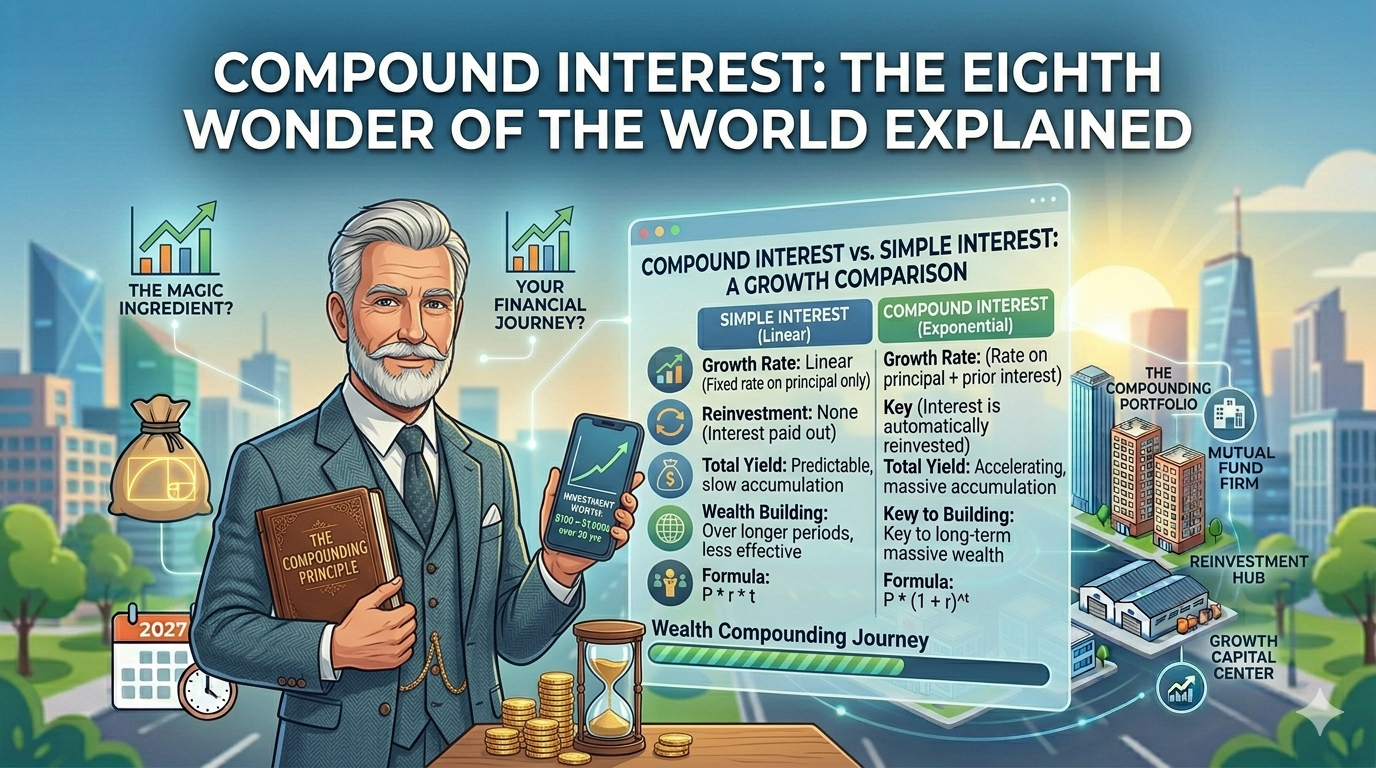
What if you could grow your money without lifting a finger—just by letting it work for you? That’s the magic of compound interest, often called the eighth wonder of the world. Albert Einstein reportedly said, “Compound interest is the most powerful force in the universe,” and for good reason. It’s not just a financial concept—it’s a wealth-building engine that rewards patience, consistency, and time. Whether you’re saving for retirement, a home, or financial freedom, understanding compound interest can transform your financial future.
What Is Compound Interest?
Compound interest is interest earned not only on your original investment (the principal) but also on the accumulated interest over time. Unlike simple interest, which only grows based on the initial amount, compound interest accelerates growth by reinvesting earnings. This creates a snowball effect—your money earns money, and that money earns even more.
For example, if you invest $1,000 at a 5% annual interest rate, you’ll earn $50 in the first year. In the second year, you earn 5% on $1,050—not just the original $1,000. Over decades, this compounding effect can turn modest savings into substantial wealth.
How Compound Interest Works: The Formula
The power of compound interest lies in its mathematical elegance. The formula is:
- A = P (1 + r/n)^(nt)
Where:
- A = the future value of the investment
- P = the principal amount (initial investment)
- r = annual interest rate (in decimal form)
- n = number of times interest is compounded per year
- t = number of years the money is invested
Even small differences in the compounding frequency—like monthly versus annually—can significantly impact your final balance. The more frequently interest compounds, the faster your wealth grows.
Why Time Is Your Greatest Ally
One of the most critical factors in compound interest is time. The earlier you start investing, the more time your money has to grow exponentially. A 25-year-old who invests $200 a month at a 7% annual return will have nearly $500,000 by age 65. Someone who starts at 35 would need to invest over $400 a month to reach the same goal.
This is why financial experts emphasize starting early. Even small contributions can lead to life-changing results when given enough time to compound. Delaying by just a few years can cost you tens of thousands in potential earnings.
Real-Life Examples of Compound Interest in Action
Imagine two friends, Maya and Rahul. Maya starts investing $100 a month at age 20, earning an average 8% annual return. By age 30, she stops investing but leaves the money to grow. Rahul starts at 30, investing $200 a month until 65, also at 8%.
By retirement, Maya—despite investing only $12,000 total—has over $300,000. Rahul, who invested $84,000, ends up with about $280,000. Maya wins, not because she saved more, but because she started earlier and let compound interest do the heavy lifting.
Ways to Harness Compound Interest
You don’t need a Wall Street degree to benefit from compound interest. Here are practical ways to apply it:
- Retirement accounts (401(k), IRA): These offer tax advantages and long-term growth potential.
- High-yield savings accounts: Earn more than traditional banks, with interest compounding daily or monthly.
- Index funds and ETFs: Low-cost investments that historically return 7–10% annually over the long term.
- Dividend reinvestment plans (DRIPs): Automatically reinvest dividends to buy more shares, accelerating compounding.
The key is consistency. Regular contributions, even small ones, combined with time, create powerful results.
Common Misconceptions About Compound Interest
Many people underestimate compound interest because its effects aren’t immediate. In the early years, growth seems slow. But after a tipping point—often called the “hockey stick” phase—the curve shoots upward dramatically.
Another myth is that you need large sums to benefit. In reality, starting with just $25 a month can grow to over $50,000 in 40 years at a 7% return. It’s not about how much you start with—it’s about starting at all.
Key Takeaways
- Compound interest earns returns on both your principal and accumulated interest.
- Time is the most powerful factor—start investing as early as possible.
- Even small, regular contributions can grow into significant wealth over decades.
- The frequency of compounding (daily, monthly, annually) affects final returns.
- Use tax-advantaged accounts and diversified investments to maximize growth.
FAQ
How is compound interest different from simple interest?
Simple interest is calculated only on the original principal amount. Compound interest includes interest on both the principal and previously earned interest, leading to exponential growth over time.
Can compound interest work against me?
Yes, in the case of loans or credit card debt. When interest compounds on what you owe, your debt can grow rapidly if not managed. Always pay off high-interest debt quickly to avoid this negative compounding.
How often should interest compound to maximize returns?
The more frequently interest compounds, the better. Daily or monthly compounding yields higher returns than annual compounding, assuming the same interest rate.
Compound interest isn’t just a financial tool—it’s a mindset. It rewards discipline, patience, and long-term thinking. By understanding and applying this “eighth wonder,” you’re not just saving money—you’re building a future where your money works as hard as you do.
