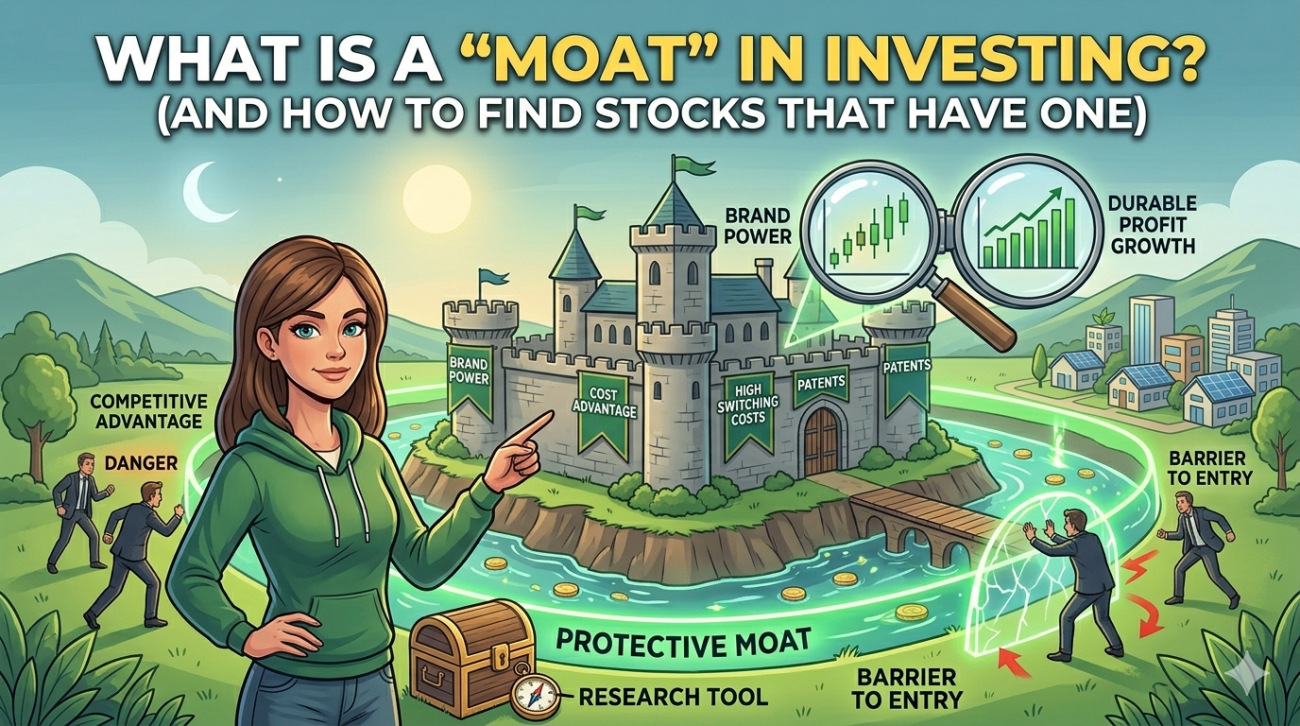
When investors talk about a company having a “moat,” they’re not referring to medieval castles or water-filled trenches. In investing, a moat is a metaphor for a business’s sustainable competitive advantage—something that protects its profits from rivals and helps it maintain long-term profitability. Just like a castle’s moat kept enemies at bay, a strong economic moat shields a company from competition, pricing pressure, and market disruption.
Understanding what a moat is—and how to spot it—can be the difference between picking a winning stock and chasing a fleeting trend. Companies with wide moats often dominate their industries, generate consistent cash flow, and deliver superior returns over time. This guide breaks down the types of moats, why they matter, and how you can identify stocks with durable competitive advantages.
Why Moats Matter in Stock Investing
A company without a moat is vulnerable. Competitors can easily replicate its products, undercut its prices, or innovate faster. But a business with a strong moat can fend off threats and maintain pricing power, customer loyalty, and market share—even in tough economic times.
Warren Buffett, one of the most successful investors of all time, has long emphasized the importance of moats. He famously said, “It’s far better to buy a wonderful company at a fair price than a fair company at a wonderful price.” That “wonderful company” almost always has a wide economic moat.
Stocks with moats tend to outperform the broader market over the long term because they’re built to last. They’re less sensitive to economic cycles, more resilient during downturns, and better positioned to capitalize on growth opportunities.
Types of Economic Moats
Not all moats are created equal. Some are narrow and temporary; others are wide and enduring. Here are the five primary types of economic moats recognized by investors:
1. Cost Advantage
Companies with a cost advantage can produce goods or deliver services at a lower cost than competitors. This allows them to either undercut rivals on price or enjoy higher profit margins. Examples include large-scale manufacturers, logistics giants, and companies with proprietary technology that reduces production expenses.
Amazon is a classic example. Its vast distribution network and automation allow it to offer lower prices while maintaining profitability—something smaller retailers can’t match.
2. Network Effects
Network effects occur when a product or service becomes more valuable as more people use it. Social media platforms like Facebook (Meta), payment systems like PayPal, and marketplaces like eBay all benefit from this moat.
The more users join, the more attractive the platform becomes—creating a self-reinforcing cycle that’s hard for new entrants to disrupt.
3. Intangible Assets
These include brand recognition, patents, regulatory licenses, and intellectual property. A strong brand like Coca-Cola or Apple commands customer loyalty and allows premium pricing. Patents protect innovations, giving companies exclusive rights to sell a product for a set period.
Pharmaceutical companies like Pfizer often rely on patent-protected drugs to maintain high margins until generics enter the market.
4. Switching Costs
When it’s difficult or expensive for customers to switch to a competitor, a company benefits from high switching costs. This is common in software, enterprise services, and specialized equipment.
Salesforce, for example, integrates deeply into a company’s operations. Migrating to another CRM system would be time-consuming and costly—giving Salesforce a powerful moat.
5. Efficient Scale
Some markets are naturally limited in size, and only a few players can operate profitably. In such cases, existing companies benefit from efficient scale—they’re big enough to be cost-effective, but the market isn’t large enough to attract many competitors.
Regional utilities or niche industrial firms often fall into this category. New entrants can’t justify the investment because the return wouldn’t be sufficient.
How to Find Stocks with a Strong Moat
Identifying moats requires more than just reading financial statements. It demands a deep understanding of the business model, industry dynamics, and competitive landscape. Here’s a practical framework to help you spot moat-backed stocks:
Analyze the Business Model
Start by asking: What makes this company unique? Does it offer something competitors can’t easily copy? Look for businesses with recurring revenue, high customer retention, or proprietary technology.
For example, Microsoft’s shift to cloud-based services (Azure, Office 365) created a sticky, subscription-based model that’s hard to replicate.
Examine Profit Margins and Returns on Capital
Companies with moats typically generate consistently high profit margins and strong returns on invested capital (ROIC). Compare these metrics over time and against industry peers.
A rising or stable ROIC above 15% is a strong indicator of a durable moat. It shows the company is efficiently using capital to generate profits.
Assess Competitive Positioning
Is the company a market leader? Does it have pricing power? Can it raise prices without losing customers? These are signs of a dominant position.
Think of companies like Google (Alphabet), which controls over 90% of the global search market. Its dominance in search and advertising creates a near-insurmountable barrier for competitors.
Look for Barriers to Entry
Ask: What would it take for a new company to enter this market and compete effectively? High capital requirements, regulatory hurdles, or complex technology can all serve as barriers.
Semiconductor manufacturers like NVIDIA face massive R&D costs and technical complexity—making it extremely difficult for new players to enter.
Evaluate Customer Loyalty and Brand Strength
Strong brands create emotional connections and reduce price sensitivity. Conduct surveys, read reviews, and analyze customer retention rates.
Apple users, for instance, often upgrade to new iPhones without considering alternatives—demonstrating powerful brand loyalty.
Red Flags: When a Moat Might Be Shrinking
Even the strongest moats can erode over time. Technological disruption, changing consumer preferences, or aggressive competition can weaken a company’s advantage.
Watch for these warning signs:
- Declining profit margins over multiple quarters
- Loss of market share to new competitors
- Increased price competition
- Patents expiring without new innovations
- Customer churn rising
For example, BlackBerry once had a strong moat in mobile communication. But the rise of Apple’s iPhone and Android devices eroded its dominance—showing that moats aren’t permanent.
Real-World Examples of Moat-Backed Stocks
Let’s look at a few companies widely recognized for their economic moats:
Apple (AAPL): Combines brand strength, ecosystem lock-in (iOS, App Store), and high switching costs. Users invested in Apple’s ecosystem are less likely to switch to Android.
Visa (V): Benefits from network effects and high switching costs. Merchants and banks rely on Visa’s global payment infrastructure, making it costly to switch.
Costco (COST): Leverages cost advantage through bulk purchasing and membership model. Its low prices and loyal customer base create a powerful retail moat.
ASML (ASML): Holds a near-monopoly in extreme ultraviolet (EUV) lithography machines used to make advanced semiconductors. Its technology is so complex that no competitor can replicate it.
Key Takeaways
- A moat in investing refers to a company’s sustainable competitive advantage that protects its profits from competition.
- Moats come in five main types: cost advantage, network effects, intangible assets, switching costs, and efficient scale.
- Stocks with strong moats often have high profit margins, strong ROIC, pricing power, and loyal customers.
- To find moat-backed stocks, analyze the business model, competitive positioning, and industry barriers.
- Even wide moats can shrink—monitor for signs of erosion like declining margins or rising competition.
FAQ
What is the difference between a narrow moat and a wide moat?
A narrow moat offers a temporary or moderate advantage that may last a few years. A wide moat is strong, durable, and likely to persist for decades. Wide-moat companies are better long-term investments.
Can a company have more than one type of moat?
Yes. Many successful companies combine multiple moats. For example, Amazon has cost advantage, network effects (via Marketplace), and high switching costs (Prime membership).
Are moats only found in large companies?
Not necessarily. While large firms often have moats, smaller companies in niche markets can also possess strong advantages—especially if they have proprietary technology or serve a specialized customer base.
Investing in companies with economic moats isn’t just about picking winners—it’s about building a portfolio of resilient, long-term performers. By focusing on businesses with durable competitive advantages, you increase your chances of achieving sustainable investment success.
