
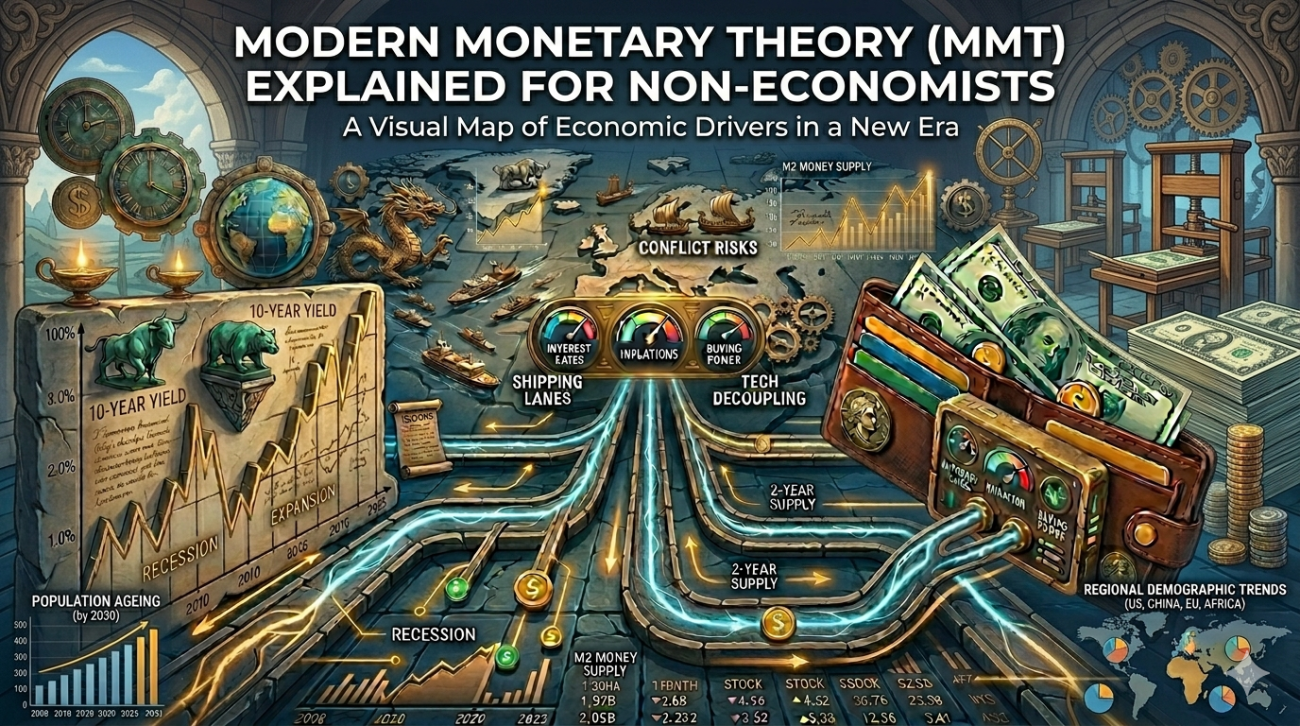
Have you ever wondered how governments keep spending money—even when they’re deeply in debt—without collapsing the economy? The answer might lie in Modern Monetary Theory (MMT), a controversial yet increasingly discussed economic framework that challenges traditional views on government spending, taxes, and national debt. If you’re not an economist, don’t worry—this guide breaks down MMT in simple, everyday language so you can understand what it really means, why it matters, and how it could shape the future of economic policy.
What Is Modern Monetary Theory (MMT)?
Modern Monetary Theory (MMT) is an economic school of thought that argues countries that control their own currency—like the U.S., Japan, or the U.K.—can’t “go broke” in the same way a household or business can. Instead of fearing deficits, MMT suggests that such governments can safely spend more than they collect in taxes, as long as inflation remains under control.
Unlike mainstream economics, which often treats government budgets like family budgets, MMT flips the script. It says that because these governments issue their own money, they don’t need to collect taxes to spend—they can create money instead. Taxes, according to MMT, serve a different purpose: they help control inflation and give value to the currency.
How Does MMT Differ from Traditional Economics?
Traditional economic thinking says governments must balance their budgets, just like families. If they spend too much, they’ll go into debt, raise taxes, or face a financial crisis. But MMT challenges this idea with three key principles:
- Sovereign currency issuers don’t face solvency risk: Countries like the U.S. that print their own money can always pay their bills in that currency.
- Deficits aren’t inherently bad: Running a budget deficit (spending more than revenue) can boost employment and growth, especially during recessions.
- Inflation, not debt, is the real limit: The danger isn’t how much a government owes, but whether too much spending causes prices to rise too quickly.
This doesn’t mean governments should print money recklessly. MMT emphasizes that spending must be tied to real resources—like labor, materials, and production capacity—not just money creation.
Where Does the Money Come From?
Under MMT, the government doesn’t need to “find” money before spending. Instead, it creates money through the central bank or Treasury. When the government spends, it injects new money into the economy. Taxes then pull some of that money back out, helping to regulate demand and prevent overheating.
Think of it like this: the government is the source of the currency. It can’t run out of dollars any more than a video game developer can run out of digital coins. But just like in a game, if too many coins flood the system, inflation (or “price glitches”) can occur.
Why Do People Support MMT?
Supporters of Modern Monetary Theory argue it offers a more realistic way to address big economic challenges. Here’s why it’s gaining attention:
- Full employment: MMT advocates for job guarantee programs, where the government acts as an employer of last resort, ensuring everyone who wants to work can find a job.
- Funding social programs: With less fear of debt, governments could fund healthcare, education, and climate initiatives without raising taxes immediately.
- Crisis response: During recessions or pandemics, MMT supports aggressive government spending to stabilize the economy.
For many, MMT is not about reckless spending—it’s about rethinking outdated fears around national debt.
Criticisms and Concerns About MMT
Not everyone is convinced. Critics warn that MMT underestimates the risks of inflation and could lead to economic instability if misapplied. They argue that even if a country can’t “go broke,” excessive money printing can devalue the currency, as seen in historical cases like Zimbabwe or Venezuela.
Another concern is political: without budget constraints, governments might overspend due to short-term political incentives rather than long-term economic health. MMT doesn’t eliminate the need for wise policy—it shifts the focus from debt to real economic outcomes like jobs and price stability.
Key Takeaways
- Modern Monetary Theory (MMT) redefines how we think about government money, debt, and spending.
- It applies only to countries that control their own currency and central bank.
- Inflation, not debt, is seen as the main economic constraint.
- MMT supports active government roles in job creation and public investment.
- While promising, it requires careful implementation to avoid economic overheating.
FAQ
Can a country really spend unlimited money under MMT?
No. While MMT says sovereign governments can’t run out of money, they can’t spend endlessly either. The real limit is inflation. If too much money chases too few goods and services, prices rise. So spending must align with the economy’s productive capacity.
Does MMT mean taxes are useless?
Not at all. Taxes serve important roles beyond funding spending: they reduce inequality, control inflation, and give value to the currency. MMT argues taxes aren’t needed to “pay for” spending but to manage economic balance.
Is MMT being used in real-world policy?
Not officially, but elements of MMT thinking have influenced policies like pandemic stimulus checks and job guarantee proposals. Economists and policymakers are increasingly debating its ideas, especially during economic crises.
Modern Monetary Theory (MMT) isn’t a magic solution—but it’s a powerful lens for rethinking how money, government, and the economy interact. Whether you agree with it or not, understanding MMT helps you see beyond traditional budget myths and engage more deeply in today’s economic debates.
