You don’t need thousands of dollars to begin building wealth. With just $50 a month, you can start investing and set yourself on a path toward financial growth. Many people believe investing is only for the wealthy, but thanks to low-cost platforms and fractional shares, even small amounts can grow significantly over time. The key is consistency, smart choices, and starting now—no matter how modest your budget may seem.
Why $50 a Month Can Make a Real Difference
It might sound too small to matter, but investing $50 monthly can grow into thousands—even tens of thousands—over decades. Thanks to compound interest, your money earns returns, and those returns earn their own returns. For example, investing $50 a month at an average annual return of 7% could grow to over $50,000 in 30 years. That’s the power of starting early and staying consistent.
Even if you can’t increase your contributions right away, the habit of investing regularly builds discipline and financial awareness. Over time, as your income grows, you can scale up your investments—but the foundation starts with that first $50.
Step-by-Step Guide to Begin Investing with $50 Monthly
1. Choose the Right Investment Platform
Look for brokerage accounts or robo-advisors that allow low minimum investments and offer fractional shares. Platforms like Fidelity, Charles Schwab, or apps like Acorns and Robinhood let you buy portions of stocks or ETFs with as little as $1. This means your $50 can be fully invested without leftover cash.
Robo-advisors are especially helpful for beginners. They automate your investments based on your risk tolerance and goals, often charging low fees. Some even offer automatic round-up features that invest your spare change.
2. Focus on Low-Cost Index Funds and ETFs
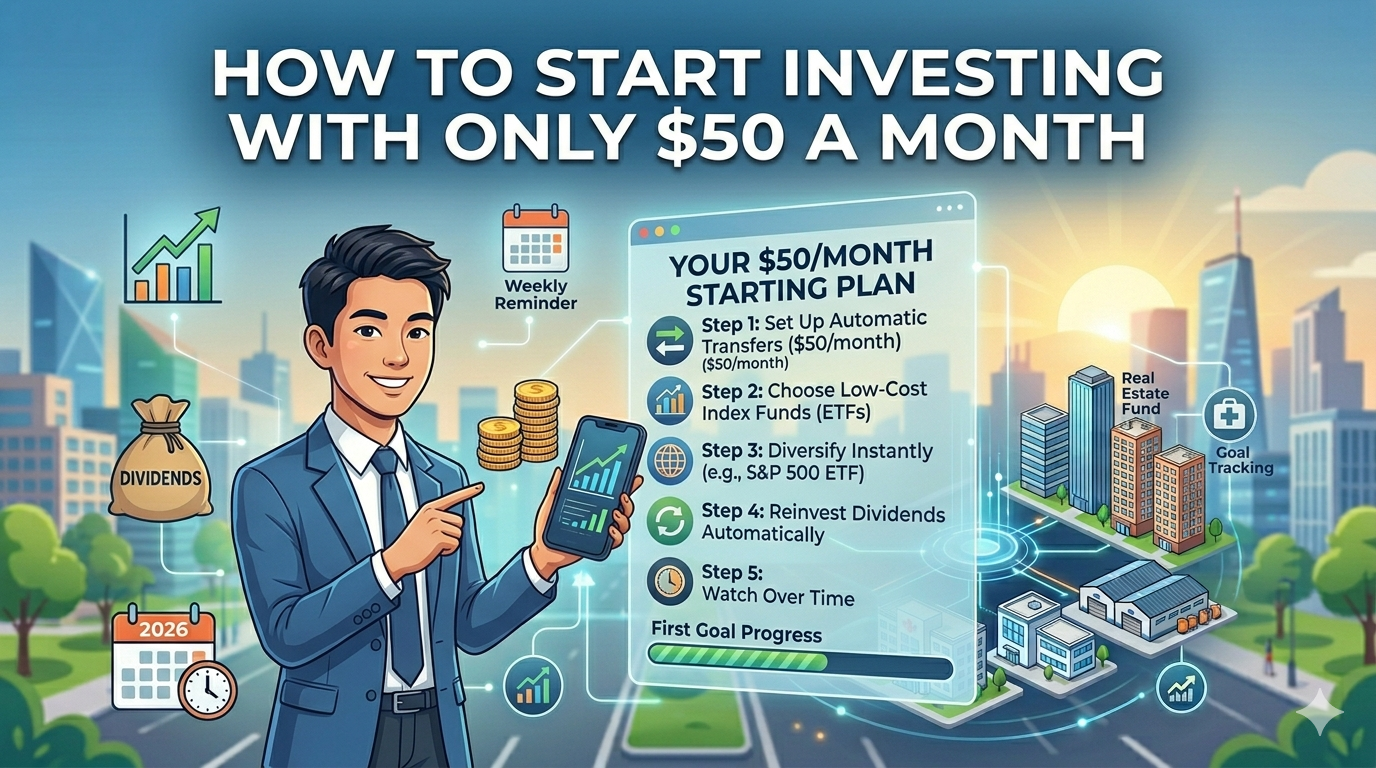
Instead of picking individual stocks, start with broad-market index funds or exchange-traded funds (ETFs). These track entire markets—like the S&P 500—and offer instant diversification. They’re also typically low-cost, with expense ratios under 0.10%, so more of your money stays invested.
Examples include Vanguard’s VOO (S&P 500 ETF) or Fidelity’s FXAIX. With fractional shares, your $50 can buy a piece of these funds, giving you exposure to hundreds of companies in one purchase.
3. Automate Your Investments
Set up automatic transfers from your bank account to your investment account every month. This “set it and forget it” strategy removes emotion and ensures consistency. Even on tight months, $50 is manageable—and automation makes it effortless.
Many platforms let you schedule recurring buys, so your $50 is invested the same day each month. This also helps you practice dollar-cost averaging, buying more shares when prices are low and fewer when they’re high.
4. Reinvest Dividends
Some index funds and ETFs pay dividends—small cash payments from company profits. Instead of taking the cash, choose to reinvest those dividends. This buys more shares automatically, accelerating your growth through compounding.
Over time, reinvested dividends can significantly boost your portfolio’s value, even if you never add another dollar beyond your $50 monthly contribution.
Common Mistakes to Avoid When Investing Small Amounts
- Paying high fees: Avoid platforms or funds with high expense ratios or transaction fees. Even small fees eat into your returns over time.
- Trying to time the market: Don’t wait for the “perfect” time to invest. Consistency beats timing. Markets go up and down, but long-term trends favor steady investors.
- Chasing hot stocks: Resist the urge to invest in trending stocks based on hype. Stick to diversified, low-cost funds for reliable growth.
- Skipping an emergency fund: Before investing, ensure you have $500–$1,000 saved for emergencies. This prevents you from withdrawing investments during tough times.
Key Takeaways
- You can start investing with as little as $50 a month using fractional shares and low-cost platforms.
- Focus on index funds and ETFs for diversification and long-term growth.
- Automate your contributions and reinvest dividends to maximize compounding.
- Avoid high fees, market timing, and emotional decisions.
- Consistency matters more than the amount—start now, even if it’s small.
FAQ: Investing with $50 a Month
Can I really build wealth with just $50 a month?
Yes. With time and compound growth, $50 monthly can grow substantially. For example, at a 7% annual return, $50 a month becomes over $50,000 in 30 years. The earlier you start, the more powerful the effect.
What’s the best type of account for small monthly investments?
A Roth IRA is ideal if you’re investing for retirement. Contributions are made with after-tax dollars, but your gains grow tax-free. For general investing, a standard brokerage account works well and offers flexibility.
Should I invest in individual stocks with $50?
It’s generally safer to start with diversified funds like ETFs. Individual stocks carry more risk, and $50 may not allow for proper diversification. Stick to broad-market funds until you’re more experienced.
Final Thoughts
Investing doesn’t require a large bank account—just commitment and the right strategy. By starting with $50 a month, you’re not just saving money; you’re building a habit that can transform your financial future. Use low-cost platforms, automate your contributions, and stay focused on the long term. Every expert investor started somewhere—and that somewhere could be your very first $50.
