
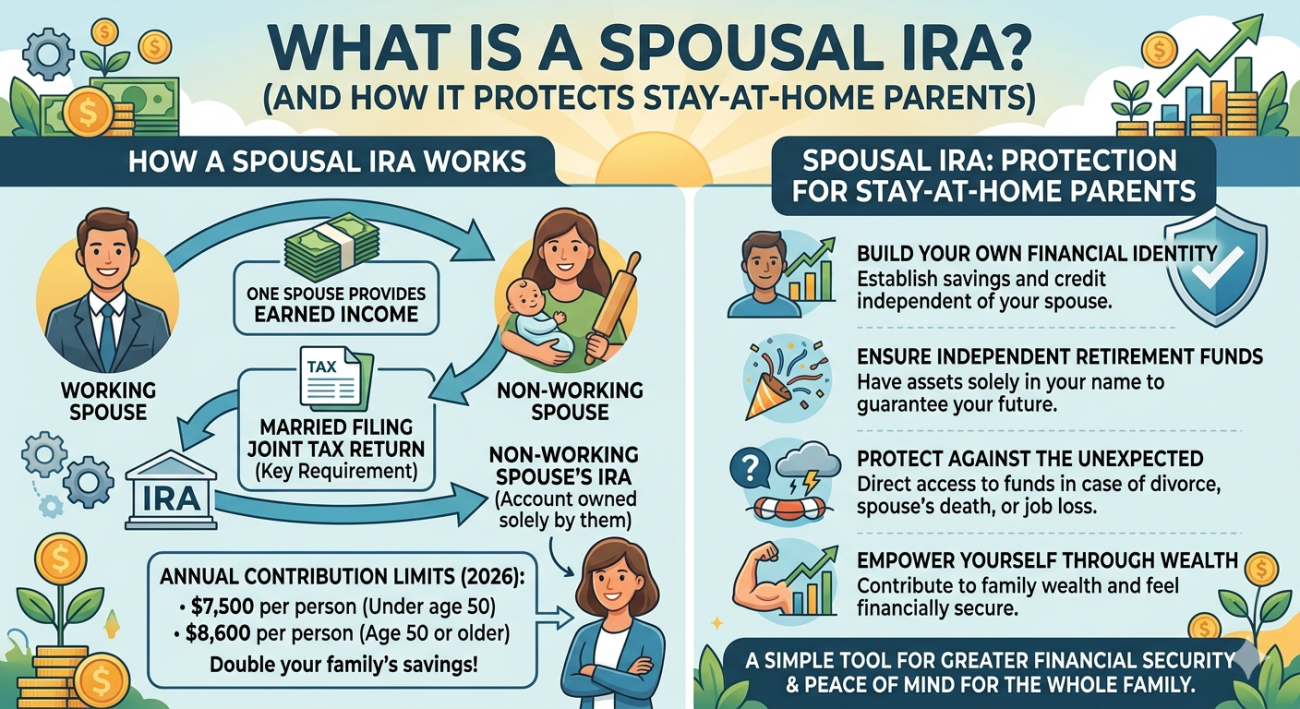
If you’re a stay-at-home parent, you might think retirement savings aren’t for you—especially if you don’t earn an income. But here’s the truth: you can still contribute to an IRA, thanks to a powerful but often overlooked tool called a Spousal IRA. A Spousal IRA allows a working spouse to contribute to an individual retirement account on behalf of a non-working spouse, ensuring both partners build a secure financial future—even if one stays home to raise children or manage the household.
This strategy isn’t just about fairness—it’s about financial protection. Without a Spousal IRA, stay-at-home parents miss out on decades of tax-advantaged growth, leaving them vulnerable in retirement. Whether you’re a full-time caregiver or temporarily out of the workforce, a Spousal IRA helps level the playing field and strengthens long-term financial stability for the entire family.
How Does a Spousal IRA Work?
A Spousal IRA operates under IRS rules that permit a married couple to fund two separate IRAs—even if only one spouse has earned income. The key requirement? The couple must file a joint tax return. The working spouse’s income is used to support contributions for both accounts, up to the annual IRA contribution limit.
For 2024, the standard contribution limit is $7,000 per person, or $8,000 if you’re age 50 or older (due to the catch-up contribution). That means a couple could contribute up to $16,000 total—$8,000 each if both are over 50—even if only one spouse earns money.
The Spousal IRA can be either a Traditional IRA or a Roth IRA, depending on your tax strategy and income level. Both offer tax advantages, but they differ in when you pay taxes: Traditional IRAs offer tax deductions now and taxable withdrawals later, while Roth IRAs are funded with after-tax dollars but grow tax-free.
Why Stay-at-Home Parents Need a Spousal IRA
Stay-at-home parents contribute immeasurably to family well-being—but their unpaid labor doesn’t count toward Social Security or employer-sponsored retirement plans. Over time, this creates a significant retirement savings gap. A Spousal IRA closes that gap by giving non-working spouses the same opportunity to save and invest for the future.
Consider this: a stay-at-home parent who starts a Spousal IRA at age 30 and contributes $6,000 annually could accumulate over $500,000 by age 65, assuming a 7% annual return. That’s real financial power—especially if the working spouse passes away or the couple divorces. Without a Spousal IRA, the non-working spouse may have little to no retirement cushion.
Beyond retirement, a Spousal IRA also provides:
- Financial independence: Even if you’re not earning, you’re building wealth.
- Tax diversification: Having both Traditional and Roth accounts gives flexibility in retirement.
- Estate planning benefits: IRAs can be passed to beneficiaries, reducing reliance on the working spouse’s assets.
Eligibility Rules for a Spousal IRA
Not every couple qualifies for a Spousal IRA. The IRS sets specific criteria to ensure the benefit is used as intended. Here’s what you need to know:
- Marital status: You must be legally married as of the end of the tax year.
- Filing status: You must file a joint tax return. Married filing separately disqualifies you.
- Earned income: The working spouse must have enough earned income to cover both contributions. For example, if you want to contribute $7,000 to each IRA, the working spouse must earn at least $14,000.
- Age limits: There’s no minimum age to open a Spousal IRA, but you must be under 73 to contribute to a Traditional IRA (as of 2024). Roth IRAs have no age limit.
Note: Unearned income—like dividends, interest, or Social Security—doesn’t count toward the earned income requirement. Only wages, salaries, self-employment income, or alimony (under pre-2019 agreements) qualify.
Traditional vs. Roth Spousal IRA: Which Is Right for You?
Choosing between a Traditional and Roth Spousal IRA depends on your current tax bracket, expected retirement income, and long-term goals. Here’s a breakdown to help you decide:
Traditional Spousal IRA
- Contributions may be tax-deductible, reducing your taxable income now.
- Investments grow tax-deferred; you pay taxes when you withdraw in retirement.
- Required Minimum Distributions (RMDs) begin at age 73.
- Best for couples who expect to be in a lower tax bracket during retirement.
Roth Spousal IRA
- Contributions are made with after-tax dollars—no upfront tax break.
- Qualified withdrawals in retirement are completely tax-free.
- No RMDs during the account holder’s lifetime.
- Ideal for younger couples or those who expect higher taxes in the future.
Many financial advisors recommend a mix of both. For example, a working spouse might contribute to a 401(k) (Traditional), while the stay-at-home spouse opens a Roth Spousal IRA. This creates tax diversification, giving you more control over your tax bill in retirement.
How to Open and Fund a Spousal IRA
Setting up a Spousal IRA is straightforward—and you don’t need a special account type. It’s simply an IRA opened in the non-working spouse’s name, funded using the working spouse’s income.
Follow these steps:
- Choose a provider: Open accounts with a reputable brokerage, bank, or robo-advisor (e.g., Fidelity, Vanguard, Charles Schwab).
- Open two IRAs: One for each spouse. Designate one as the “Spousal IRA” during setup.
- Fund the accounts: Transfer money from a joint or working spouse’s account. Contributions can be made anytime up to the tax filing deadline (typically April 15 of the following year).
- Invest wisely: Don’t let the money sit in cash. Choose low-cost index funds, target-date funds, or a diversified portfolio based on your risk tolerance.
Pro tip: Automate contributions. Even $200 per month adds up over time and builds a strong habit of saving.
Common Misconceptions About Spousal IRAs
Despite their benefits, Spousal IRAs are often misunderstood. Let’s clear up some myths:
- Myth: “Only the working spouse can contribute.”
Fact: Both spouses can contribute—up to the annual limit each—as long as the working spouse has enough earned income. - Myth: “You need a special ‘Spousal IRA’ account.”
Fact: It’s just a regular IRA in the non-working spouse’s name. The “spousal” part refers to the funding rule, not the account type. - Myth: “It’s only for full-time homemakers.”
Fact: Anyone without earned income—including students, caregivers, or those on sabbatical—can benefit. - Myth: “You lose access to the money.”
Fact: You can withdraw contributions (not earnings) from a Roth IRA at any time without penalty. Traditional IRAs have more restrictions.
Key Takeaways
- A Spousal IRA allows a working spouse to fund an IRA for a non-working spouse, even if they have no income.
- Both spouses can contribute up to $7,000 annually (or $8,000 if 50+), for a total of $16,000 in 2024.
- You must be married and file jointly to qualify.
- Spousal IRAs protect stay-at-home parents by building retirement savings and financial independence.
- Choose between Traditional (tax-deferred) and Roth (tax-free growth) based on your tax situation.
- Start early—even small contributions grow significantly over time thanks to compound interest.
Frequently Asked Questions
Can I open a Spousal IRA if my spouse is self-employed?
Yes. Self-employment income counts as earned income, so a self-employed spouse can fund a Spousal IRA as long as they have sufficient net earnings to cover both contributions.
What happens to a Spousal IRA in a divorce?
A Spousal IRA is owned by the non-working spouse, so it’s considered their individual asset. However, in a divorce, it may be subject to division depending on state laws and prenuptial agreements. It’s wise to consult a financial advisor or attorney during separation.
Can I contribute to a Spousal IRA if I’m over 73?
You can contribute to a Roth Spousal IRA at any age, as long as your spouse has earned income. However, you cannot contribute to a Traditional Spousal IRA once you reach age 73 due to RMD rules.
Final Thoughts
A Spousal IRA isn’t just a retirement tool—it’s a statement of equality and long-term care. For stay-at-home parents, it’s a way to ensure that years of unpaid, invaluable work are recognized with financial security. By leveraging this IRS-approved strategy, couples can build a stronger, more resilient future together—no matter who brings in the paycheck.
Don’t let the myth of “no income, no savings” hold you back. With a Spousal IRA, every parent—working or not—can take control of their financial destiny.
