
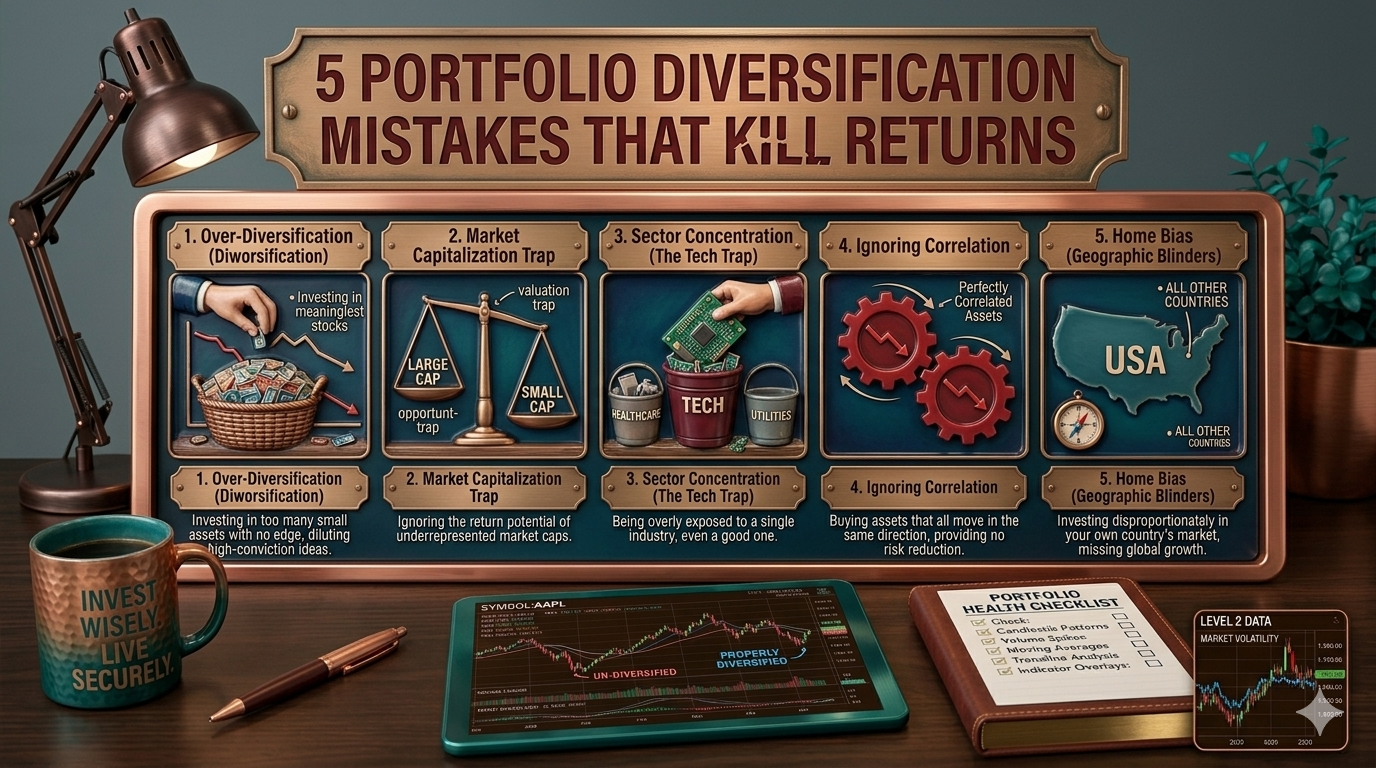
Are you diversifying your investment portfolio the right way—or are you unknowingly sabotaging your returns? Many investors believe that simply spreading money across multiple assets guarantees safety and growth. But portfolio diversification mistakes can quietly erode profits, increase risk, and leave you worse off than if you’d stayed focused. The truth is, poor diversification often does more harm than good. In this article, we break down the five most common errors that kill returns and how to avoid them.
1. Over-Diversification: The Illusion of Safety
More isn’t always better. While diversification reduces risk, over-diversifying can dilute returns to near-zero levels. Holding too many assets—especially low-performing ones—creates a “closet index” portfolio that mirrors the market but underperforms due to fees and lack of conviction.
For example, owning 50 individual stocks across identical sectors adds complexity without meaningful risk reduction. Instead, aim for strategic diversification: a balanced mix of 15–20 high-conviction assets across uncorrelated classes like stocks, bonds, real estate, and alternative investments.
- Avoid spreading capital too thin across too many funds or ETFs.
- Focus on quality over quantity—each holding should add unique value.
- Regularly review and trim underperforming or redundant positions.
2. Ignoring Correlation Between Assets
True diversification means holding assets that don’t move in lockstep. Yet many investors pile into assets that appear different but behave similarly during market swings. For instance, tech stocks, growth ETFs, and crypto may all crash together during a risk-off event.
To build a resilient portfolio, analyze asset correlation—not just sector or geography. Include assets with low or negative correlation, such as Treasury bonds, gold, or inflation-protected securities, to cushion downturns.
- Use historical correlation data to assess how assets move together.
- Mix equity-heavy holdings with defensive assets like utilities or consumer staples.
- Consider alternative investments (e.g., private credit, REITs) for true diversification.
3. Chasing Performance Instead of Balancing Risk
It’s tempting to allocate more capital to last year’s top performers—but this reactive approach often leads to buying high and selling low. Performance-chasing disrupts portfolio balance and increases exposure to overvalued assets.
Instead, adopt a risk-adjusted allocation strategy. Define your risk tolerance, set target allocations, and rebalance periodically—not based on hype, but on disciplined thresholds.
- Rebalance quarterly or when allocations drift by 5% or more.
- Use dollar-cost averaging to avoid timing the market.
- Stick to your investment plan, even during market euphoria or panic.
4. Neglecting Geographic and Currency Diversification
Many investors overweight their home country, assuming familiarity equals safety. But domestic markets can underperform for years—think Japan in the 1990s or the U.S. during the 2000s. Geographic diversification spreads risk and taps into global growth opportunities.
Additionally, currency risk matters. If your portfolio is 100% in USD assets and the dollar weakens, your real returns shrink—even if markets rise. Including international equities and foreign-denominated bonds hedges this risk.
- Allocate 20–40% of equity holdings to international markets.
- Consider emerging markets for higher growth potential (with higher risk).
- Use currency-hedged funds if volatility is a concern.
5. Failing to Reassess Diversification Over Time
Diversification isn’t a “set it and forget it” strategy. Life changes, markets evolve, and asset behaviors shift. A portfolio built five years ago may no longer reflect your goals, risk tolerance, or economic conditions.
Regular reviews ensure your diversification strategy stays aligned with your objectives. Major life events—like retirement, inheritance, or career changes—demand a portfolio reassessment.
- Conduct an annual portfolio audit.
- Update allocations based on life stage and financial goals.
- Adjust for macroeconomic shifts (e.g., rising interest rates, inflation).
Key Takeaways
- Avoid over-diversification—focus on high-quality, uncorrelated assets.
- Check asset correlation to ensure true risk reduction.
- Rebalance based on risk, not recent performance.
- Include global and currency-diversified holdings.
- Review and adjust your portfolio regularly.
Smart diversification isn’t about owning everything—it’s about owning the right mix. By avoiding these five common mistakes, you’ll build a portfolio that doesn’t just survive volatility, but thrives through it.
FAQ
How many stocks are enough for proper diversification?
For most individual investors, 15–20 well-chosen stocks across different sectors provide sufficient diversification. Beyond that, marginal benefits decline, and management complexity increases.
Can too much diversification hurt returns?
Yes. Over-diversification can lead to index-like performance with higher fees and no alpha. It’s better to hold fewer, high-conviction assets than dozens of mediocre ones.
Should I diversify across cryptocurrencies?
Cryptocurrencies can add diversification due to low correlation with traditional assets, but they’re highly volatile. Limit exposure to 1–5% of your portfolio and only invest what you can afford to lose.
